markus sent a chain letter to his friends, asking them to forward the letter to more friends.\n\nthe…
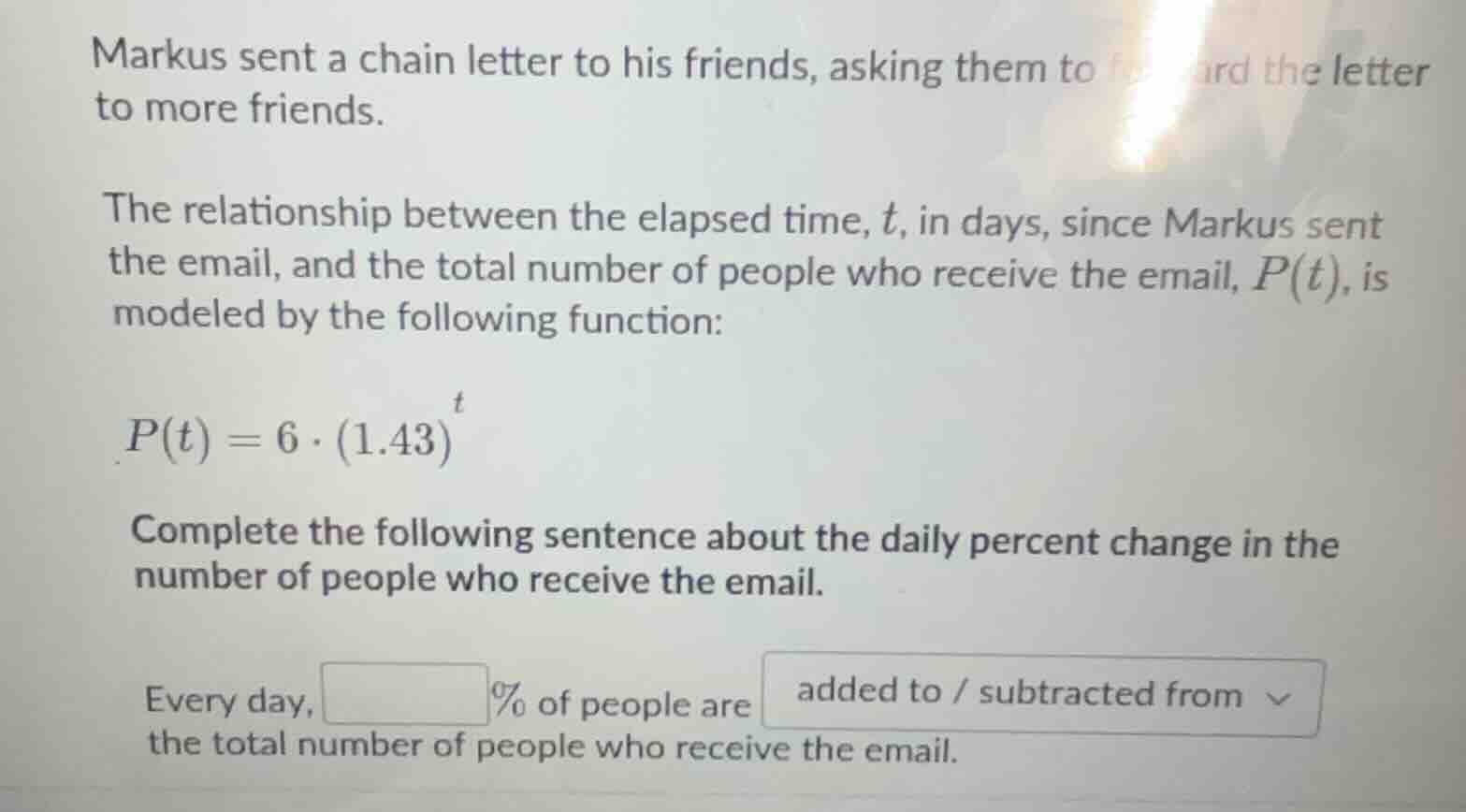
markus sent a chain letter to his friends, asking them to forward the letter to more friends.\n\nthe relationship between the elapsed time, $t$, in days, since markus sent the email, and the total number of people who receive the email, $p(t)$, is modeled by the following function:\n$p(t) = 6 \\cdot (1.43)^t$\n\ncomplete the following sentence about the daily percent change in the number of people who receive the email.\n\nevery day, ____% of people are added to / subtracted from the total number of people who receive the email.
Answer
Explanation:
Step1: Identify growth factor form
Exponential function: $P(t) = a \cdot (1+r)^t$, where $1+r$ is growth factor, $r$ is daily rate.
Step2: Match to given function
Given $P(t)=6 \cdot (1.43)^t$, so $1+r=1.43$.
Step3: Solve for rate $r$
$r = 1.43 - 1 = 0.43$ Convert to percentage: $0.43 \times 100 = 43%$
Step4: Determine change direction
Since $r>0$, people are added.
Answer:
Every day, 43% of people are added to the total number of people who receive the email.