when marques commutes to work, the amount of time it takes him to arrive is normally distributed with a mean…
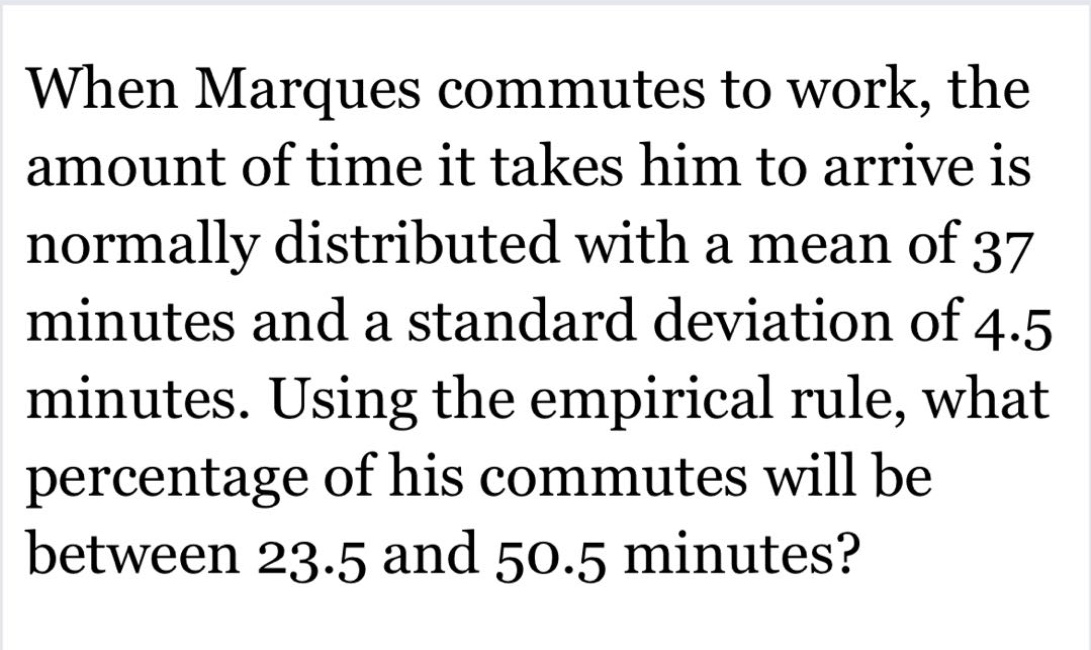
when marques commutes to work, the amount of time it takes him to arrive is normally distributed with a mean of 37 minutes and a standard deviation of 4.5 minutes. using the empirical rule, what percentage of his commutes will be between 23.5 and 50.5 minutes?
Answer
Explanation:
Step1: Calculate number of standard - deviations from the mean
First, find how many standard deviations 23.5 and 50.5 are from the mean. The formula for the z - score is $z=\frac{x-\mu}{\sigma}$, where $\mu$ is the mean, $\sigma$ is the standard deviation, and $x$ is the value. For $x = 23.5$, $\mu=37$, and $\sigma = 4.5$, $z_1=\frac{23.5 - 37}{4.5}=\frac{- 13.5}{4.5}=-3$. For $x = 50.5$, $\mu = 37$, and $\sigma=4.5$, $z_2=\frac{50.5 - 37}{4.5}=\frac{13.5}{4.5}=3$.
Step2: Apply the empirical rule
The empirical rule for a normal distribution states that approximately 99.7% of the data lies within 3 standard deviations of the mean. That is, $P(\mu - 3\sigma<X<\mu + 3\sigma)\approx99.7%$. Since $23.5=\mu - 3\sigma$ and $50.5=\mu + 3\sigma$, the percentage of his commutes between 23.5 and 50.5 minutes is 99.7%.
Answer:
99.7%