maud and billy wanted to know if theres a difference between the modes of transportation used by men and…
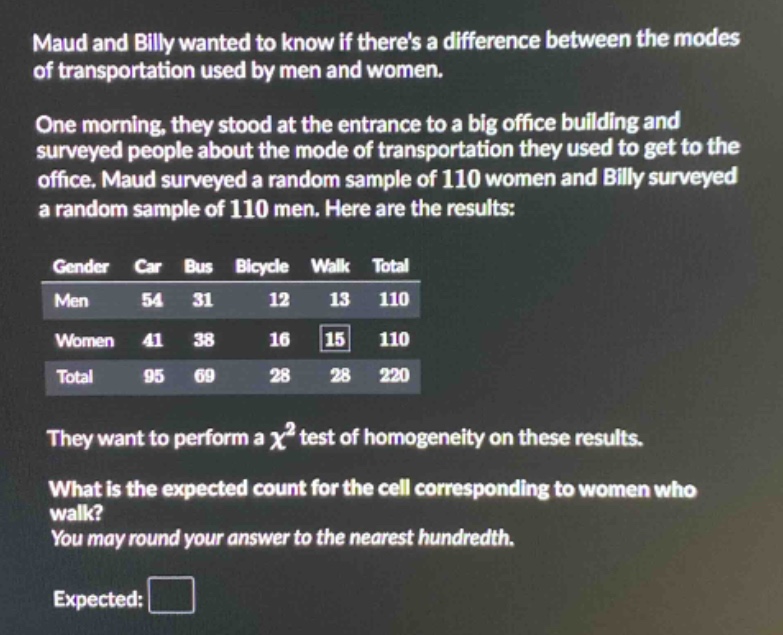
maud and billy wanted to know if theres a difference between the modes of transportation used by men and women. one morning, they stood at the entrance to a big office building and surveyed people about the mode of transportation they used to get to the office. maud surveyed a random sample of 110 women and billy surveyed a random sample of 110 men. here are the results: gender car bus bicycle walk total men 54 31 12 13 110 women 41 38 16 15 110 total 95 69 28 28 220 they want to perform a $chi^{2}$ test of homogeneity on these results. what is the expected count for the cell corresponding to women who walk? you may round your answer to the nearest hundredth. expected:
Answer
Answer:
14.00
Explanation:
Step1: Recall expected - count formula
$E_{ij}=\frac{R_i\times C_j}{n}$ where $R_i$ is the row - total, $C_j$ is the column - total, and $n$ is the grand total.
Step2: Identify values
For the cell of women who walk: The row - total for women ($R$) is 110. The column - total for walkers ($C$) is 28. The grand total ($n$) is 220.
Step3: Calculate expected count
$E=\frac{110\times28}{220}$ $E = 14.00$