the mean percent of childhood asthma prevalence in 43 cities is $2.13\\%$. a random sample of 34 of these…
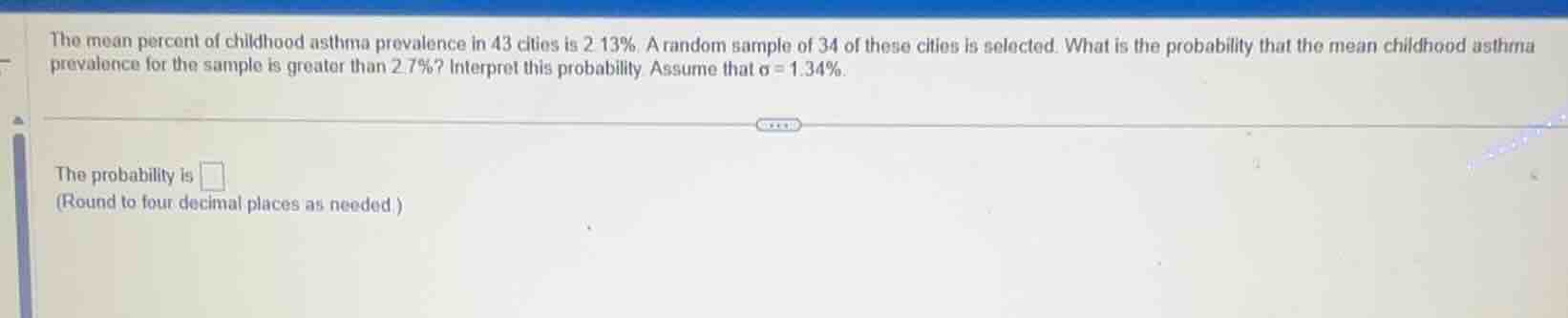
the mean percent of childhood asthma prevalence in 43 cities is $2.13\\%$. a random sample of 34 of these cities is selected. what is the probability that the mean childhood asthma prevalence for the sample is greater than $2.7\\%$? interpret this probability. assume that $\\sigma = 1.34\\%$.\n\nthe probability is ____\n(round to four decimal places as needed.)
Answer
Explanation:
Step1: Identify given parameters
$N = 43, \mu = 2.13, n = 34, \sigma = 1.34, \bar{x} > 2.7$
Step2: Calculate finite population correction factor
$FPC = \sqrt{\frac{N - n}{N - 1}} = \sqrt{\frac{43 - 34}{43 - 1}} = \sqrt{\frac{9}{42}} \approx 0.4629$
Step3: Calculate standard error of mean
$\sigma_{\bar{x}} = \frac{\sigma}{\sqrt{n}} \times FPC = \frac{1.34}{\sqrt{34}} \times 0.4629 \approx 0.1064$
Step4: Calculate the z-score
$z = \frac{\bar{x} - \mu}{\sigma_{\bar{x}}} = \frac{2.7 - 2.13}{0.1064} \approx 5.3571$
Step5: Determine the probability
$P(\bar{x} > 2.7) = P(z > 5.36) \approx 0.0000$
Answer:
The probability is 0.0000. Interpretation: It is extremely unlikely (virtually impossible) that a random sample of 34 cities will have a mean childhood asthma prevalence greater than 2.7%.