meiling and jackie are playing a game of chance with a six - sided number cube. the sides of the cube are…
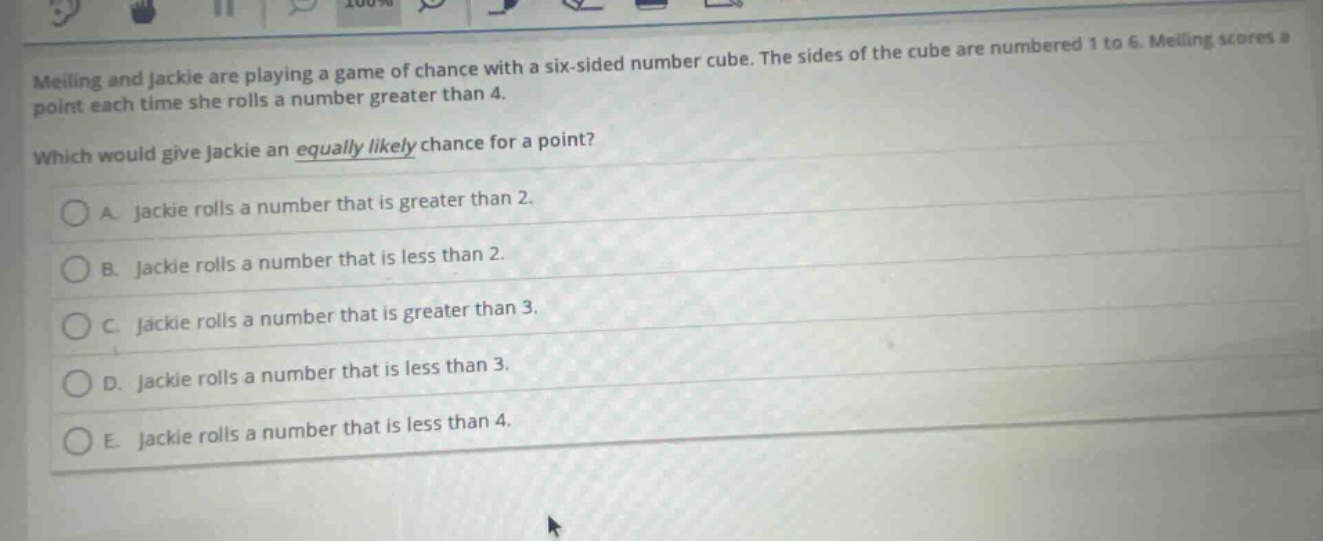
meiling and jackie are playing a game of chance with a six - sided number cube. the sides of the cube are numbered 1 to 6. meiling scores a point each time she rolls a number greater than 4. which would give jackie an equally likely chance for a point? a. jackie rolls a number that is greater than 2. b. jackie rolls a number that is less than 2. c. jackie rolls a number that is greater than 3. d. jackie rolls a number that is less than 3. e. jackie rolls a number that is less than 4.
Answer
Answer:
D. Jackie rolls a number that is less than 3.
Explanation:
Step1: Calculate Meiling's winning - probability
Meiling scores a point when she rolls a number greater than 4. The numbers greater than 4 on a six - sided cube are 5 and 6. So the number of favorable outcomes for Meiling is 2, and the total number of outcomes is 6. The probability of Meiling scoring a point, $P(M)=\frac{2}{6}=\frac{1}{3}$.
Step2: Analyze each option for Jackie's probability
Option A:
The numbers greater than 2 are 3, 4, 5, 6. The number of favorable outcomes is 4. So the probability $P(A)=\frac{4}{6}=\frac{2}{3}$.
Option B:
The numbers less than 2 are 1. The number of favorable outcomes is 1. So the probability $P(B)=\frac{1}{6}$.
Option C:
The numbers greater than 3 are 4, 5, 6. The number of favorable outcomes is 3. So the probability $P(C)=\frac{3}{6}=\frac{1}{2}$.
Option D:
The numbers less than 3 are 1 and 2. The number of favorable outcomes is 2. So the probability $P(D)=\frac{2}{6}=\frac{1}{3}$, which is the same as Meiling's winning probability.
Option E:
The numbers less than 4 are 1, 2, 3. The number of favorable outcomes is 3. So the probability $P(E)=\frac{3}{6}=\frac{1}{2}$.