michael has 3 quarters, 2 dimes, and 3 nickels in his pocket. he randomly draws two coins from his pocket…
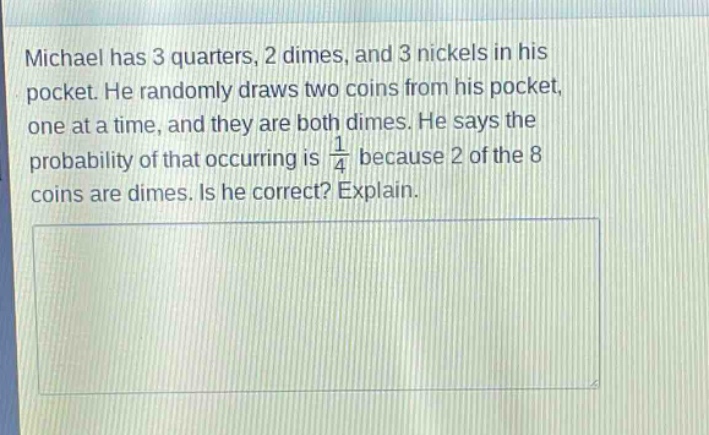
michael has 3 quarters, 2 dimes, and 3 nickels in his pocket. he randomly draws two coins from his pocket, one at a time, and they are both dimes. he says the probability of that occurring is $\frac{1}{4}$ because 2 of the 8 coins are dimes. is he correct? explain.
Answer
Explanation:
Step1: Calculate total number of coins
There are (3 + 2+3=8) coins initially.
Step2: Calculate probability of first - dime draw
The probability of drawing a dime on the first draw is (\frac{2}{8}) since there are 2 dimes out of 8 coins.
Step3: Calculate probability of second - dime draw
After drawing one dime, there is 1 dime left and 7 coins left. So the probability of drawing a dime on the second draw is (\frac{1}{7}).
Step4: Calculate combined probability
Using the multiplication rule for independent events (in the case of sequential draws without replacement), the probability of drawing two dimes is (\frac{2}{8}\times\frac{1}{7}=\frac{2}{56}=\frac{1}{28}\neq\frac{1}{4}).
Answer:
No, he is not correct. The probability of drawing two dimes is (\frac{1}{28}), not (\frac{1}{4}).