mike is playing a game where a ball is hidden under one of 5 cups. mike guesses which cup contains the ball…
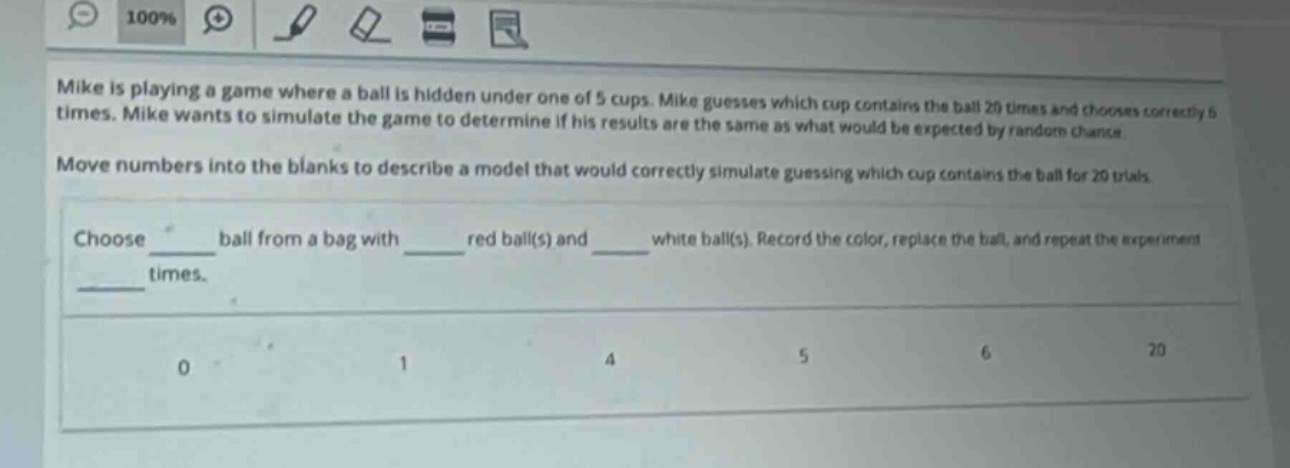
mike is playing a game where a ball is hidden under one of 5 cups. mike guesses which cup contains the ball 20 times and chooses correctly 6 times. mike wants to simulate the game to determine if his results are the same as what would be expected by random chance. move numbers into the blanks to describe a model that would correctly simulate guessing which cup contains the ball for 20 trials. choose ____ ball from a bag with ____ red ball(s) and ____ white ball(s). record the color, replace the ball, and repeat the experiment ____ times. 0 1 4 5 6 20
Answer
Explanation:
Step1: Analyze probability of correct guess
The probability of correctly guessing which of 5 cups has the ball is $\frac{1}{5}$. We want to create a ball - bag model with the same probability.
Step2: Determine ball - bag composition
If we have 1 red ball (representing a correct guess) and 4 white balls (representing incorrect guesses) in a bag, the probability of picking the red ball is $\frac{1}{1 + 4}=\frac{1}{5}$.
Step3: Set number of trials
We need to repeat the experiment 20 times to match the 20 trials of Mike's cup - guessing game.
Answer:
Choose 1 ball from a bag with 1 red ball(s) and 4 white ball(s). Record the color, replace the ball, and repeat the experiment 20 times.