mixed exercises cards suppose you pull a card from a standard 52 - card deck. find the probability of each…
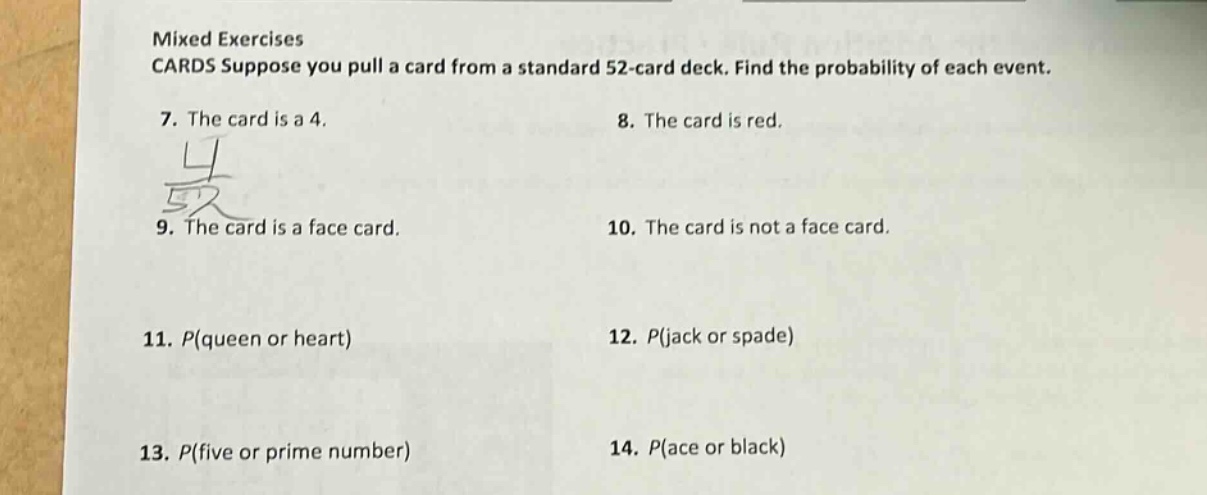
mixed exercises cards suppose you pull a card from a standard 52 - card deck. find the probability of each event. 7. the card is a 4. 8. the card is red. 9. the card is a face card. 10. the card is not a face card. 11. p(queen or heart) 12. p(jack or spade) 13. p(five or prime number) 14. p(ace or black)
Answer
Answer:
- $\frac{1}{13}$
- $\frac{1}{2}$
- $\frac{3}{13}$
- $\frac{10}{13}$
- $\frac{4 + 13 - 1}{52}=\frac{4}{13}$
- $\frac{4+13 - 1}{52}=\frac{4}{13}$
- $\frac{4+4 - 1}{52}=\frac{7}{52}$
- $\frac{4+26 - 2}{52}=\frac{7}{13}$
Explanation:
Step1: Recall probability formula
$P(A)=\frac{n(A)}{n(S)}$, where $n(A)$ is number of elements in event $A$ and $n(S) = 52$ (total cards).
Step2: Solve 7
There are 4 cards with number 4 in a deck. So $n(A)=4$, $P=\frac{4}{52}=\frac{1}{13}$.
Step3: Solve 8
There are 26 red - cards. So $n(A) = 26$, $P=\frac{26}{52}=\frac{1}{2}$.
Step4: Solve 9
There are 12 face - cards (4 Jacks, 4 Queens, 4 Kings). So $n(A)=12$, $P=\frac{12}{52}=\frac{3}{13}$.
Step5: Solve 10
Number of non - face cards is $52 - 12=40$. So $n(A)=40$, $P=\frac{40}{52}=\frac{10}{13}$.
Step6: Solve 11
Number of queens $n(Q)=4$, number of hearts $n(H)=13$, number of queen of hearts $n(Q\cap H)=1$. Using $P(Q\cup H)=P(Q)+P(H)-P(Q\cap H)=\frac{4 + 13 - 1}{52}=\frac{4}{13}$.
Step7: Solve 12
Number of jacks $n(J)=4$, number of spades $n(S)=13$, number of jack of spades $n(J\cap S)=1$. Using $P(J\cup S)=P(J)+P(S)-P(J\cap S)=\frac{4 + 13 - 1}{52}=\frac{4}{13}$.
Step8: Solve 13
Number of fives $n(5)=4$, prime - numbered cards are 2, 3, 5, 7 with 4 cards of each value, but 5 is double - counted. So $n(A)=4 + 4-1 = 7$, $P=\frac{7}{52}$.
Step9: Solve 14
Number of aces $n(Ace)=4$, number of black cards $n(B)=26$, number of black aces $n(Ace\cap B)=2$. Using $P(Ace\cup B)=P(Ace)+P(B)-P(Ace\cap B)=\frac{4+26 - 2}{52}=\frac{7}{13}$.