in the mountains of brazil, barbacenia tomentosa and barbacenia macrantha - two plants in the velloziaceae…
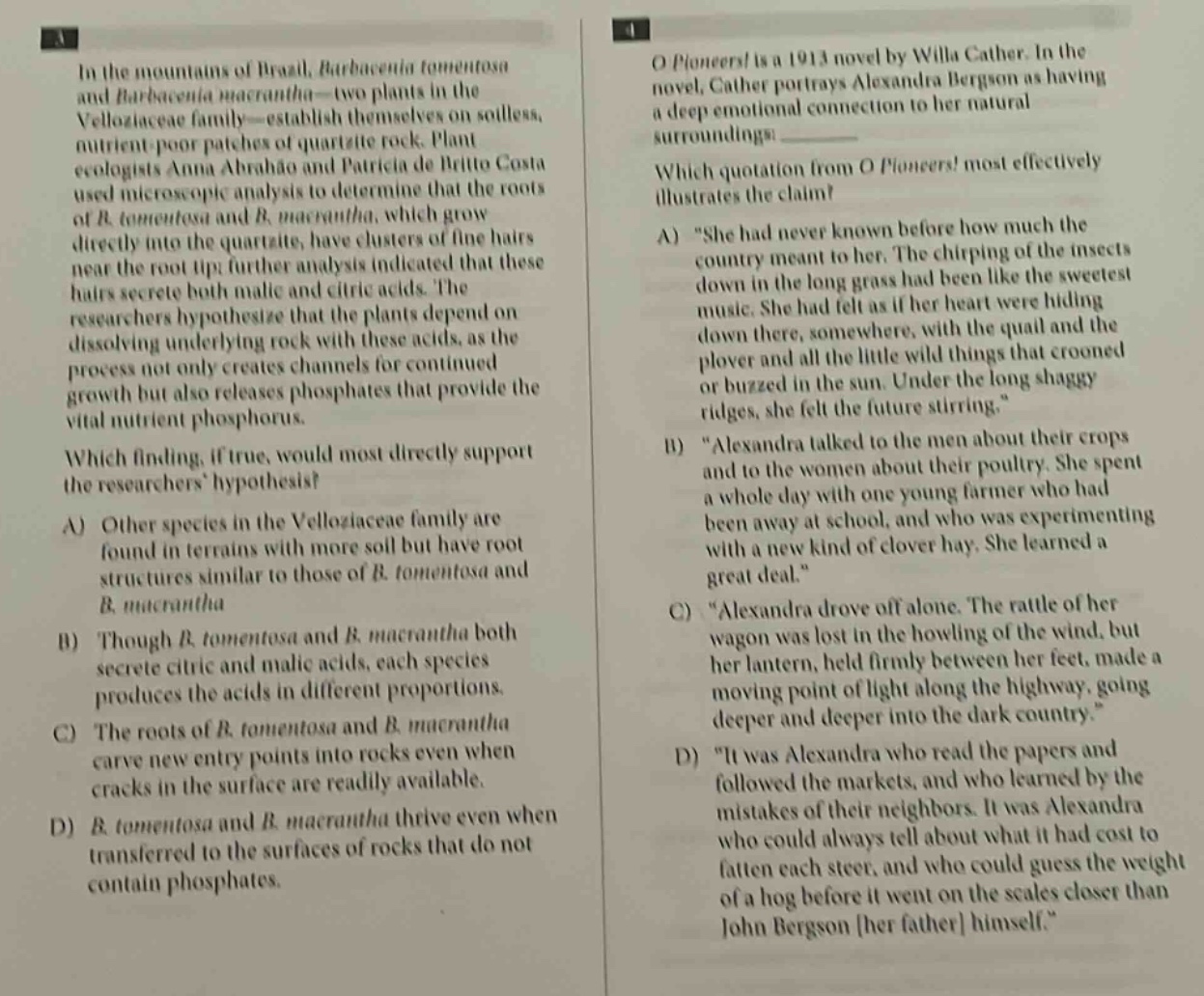
in the mountains of brazil, barbacenia tomentosa and barbacenia macrantha - two plants in the velloziaceae family - establish themselves on soil - less, nutrient - poor patches of quartzite rock. plant ecologists anna abrahao and patricia de britto costa used microscopic analysis to determine that the roots of b. tomentosa and b. macrantha, which grow directly into the quartzite, have clusters of fine hairs near the root tip; further analysis indicated that these hairs secrete both malic and citric acids. the researchers hypothesize that the plants depend on dissolving underlying rock with these acids, as the process not only creates channels for continued growth but also releases phosphates that provide the vital nutrient phosphorus. which finding, if true, would most directly support the researchers hypothesis? a) other species in the velloziaceae family are found in terrains with more soil but have root structures similar to those of b. tomentosa and b. macrantha. b) though b. tomentosa and b. macrantha both secrete citric and malic acids, each species produces the acids in different proportions. c) the roots of b. tomentosa and b. macrantha carve new entry points into rocks even when cracks in the surface are readily available. d) b. tomentosa and b. macrantha thrive even when transferred to the surfaces of rocks that do not contain phosphates. o pioneers! is a 1913 novel by willa cather. in the novel, cather portrays alexandra bergson as having a deep emotional connection to her natural surroundings. which quotation from o pioneers! most effectively illustrates the claim? a) \she had never known before how much the country meant to her. the chirping of the insects down in the long grass had been like the sweetest music. she had felt as if her heart were hiding down there, somewhere, with the quail and the plover and all the little wild things that crooned or buzzed in the sun. under the long shaggy ridges, she felt the future stirring.\ b) \alexandra talked to the men about their crops and to the women about their poultry. she spent a whole day with one young farmer who had been away at school, and who was experimenting with a new kind of clover hay. she learned a great deal.\ c) \alexandra drove off alone. the rattle of her wagon was lost in the howling of the wind, but her lantern, held firmly between her feet, made a moving point of light along the highway, going deeper and deeper into the dark country.\ d) \it was alexandra who read the papers and followed the markets, and who learned by the mistakes of their neighbors. it was alexandra who could always tell about what it had cost to fatten each steer, and who could guess the weight of a hog before it went on the scales closer than john bergson her father himself.\
Answer
Brief Explanations:
- For the first question about plant hypothesis:
- The researchers' hypothesis is that the plants' acid - secreting roots dissolve rock, creating growth channels and releasing phosphorus. Option C shows that the roots carve new entry points into rocks even when surface cracks are available, which directly supports the idea that the roots are actively involved in the rock - dissolving process for growth.
- For the second question about the novel:
- The claim is that Alexandra has a deep emotional connection to her natural surroundings. Option A describes her emotional response to the sounds and presence of natural elements like insects, quail, and plover, effectively illustrating her connection to nature.
Answer:
- C
- A