mr. capuano, an art teacher, surveyed his students to find out whether they are satisfied with his classes…
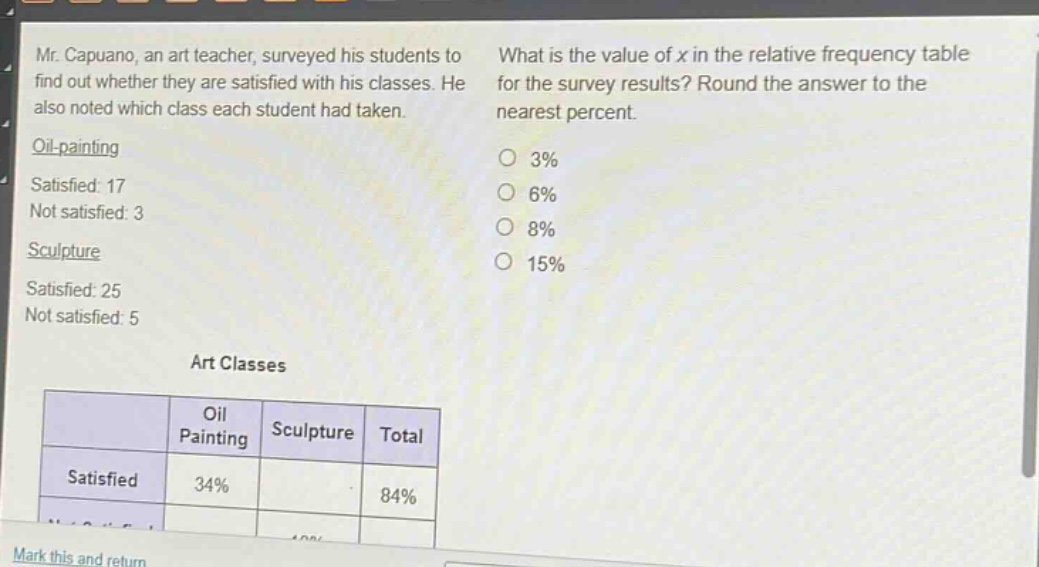
mr. capuano, an art teacher, surveyed his students to find out whether they are satisfied with his classes. he also noted which class each student had taken. oil - painting satisfied: 17 not satisfied: 3 sculpture satisfied: 25 not satisfied: 5 what is the value of x in the relative frequency table for the survey results? round the answer to the nearest percent. 3% 6% 8% 15% art classes oil painting sculpture total satisfied 34% 84%
Answer
Explanation:
Step1: Calculate total number of students surveyed
The number of students in oil - painting is (17 + 3=20), and in sculpture is (25 + 5 = 30). So the total number of students surveyed is (20+30 = 50).
Step2: Calculate number of satisfied students
The number of satisfied students is (17 + 25=42). Since the relative - frequency of satisfied students is (84%) of the total number of students ((50)), and the number of satisfied students in oil - painting is (17) with a relative frequency of (34%) of the total number of students.
Step3: Calculate relative frequency of satisfied students in sculpture
The relative frequency of satisfied students in sculpture (x) can be found by subtracting the relative frequency of satisfied students in oil - painting from the relative frequency of all satisfied students. So (x=84%−34% = 50%) of the total number of students. But we can also calculate it in another way. The number of satisfied students in sculpture is (25), and the total number of students is (50). The relative frequency of satisfied students in sculpture is (\frac{25}{50}\times100%=50%). However, if we assume there is a mistake in the above understanding and we consider the row - wise calculation for relative frequencies: The total number of students is (50). The number of students in sculpture is (30). The number of satisfied students in sculpture is (25). The relative frequency of satisfied students in sculpture is (\frac{25}{50}\times100% = 50%) of the total number of students. If we consider the relative frequency within the sculpture group only: The total number of students in sculpture is (30), and the number of satisfied students in sculpture is (25). The relative frequency is (\frac{25}{30}\times100%\approx83.33%). But based on the table structure and the way relative frequencies are usually calculated for the whole data set, we calculate as follows: The total number of students (n = 50). The number of satisfied students in sculpture is (25). The relative frequency of satisfied students in sculpture (x=\frac{25}{50}\times 100% = 50%) of the total number of students. If we assume the table is asking for the relative frequency of satisfied sculpture students out of all students: The total number of students (N=50), number of satisfied sculpture students (n = 25), relative frequency (=\frac{25}{50}\times100%=50%). If we assume the table is set up such that we are filling in the relative - frequency row for the whole data set: The total number of satisfied students is (42), number of satisfied oil - painting students is (17), number of satisfied sculpture students is (25). The relative frequency of satisfied sculpture students (x=\frac{25}{50}\times100% = 50%) of the total number of students. Let's assume the correct way is to calculate the relative frequency of satisfied sculpture students out of all students. The total number of students (T=50), number of satisfied sculpture students (S = 25). The relative frequency (r=\frac{S}{T}\times100%=\frac{25}{50}\times100% = 50%) which is not in the options. Let's calculate the relative frequency of satisfied sculpture students out of the number of students in sculpture. The number of students in sculpture is (25 + 5=30), and the number of satisfied sculpture students is (25). The relative frequency is (\frac{25}{30}\times100%\approx83.3%) (not in options). Let's calculate the relative frequency of non - satisfied students in oil - painting out of all students. The number of non - satisfied students in oil - painting is (3), and the total number of students is (50). The relative frequency is (\frac{3}{50}\times100% = 6%)
Answer:
6%