a music professor is interested in the effects of listening to music while memorizing a list of words. she…
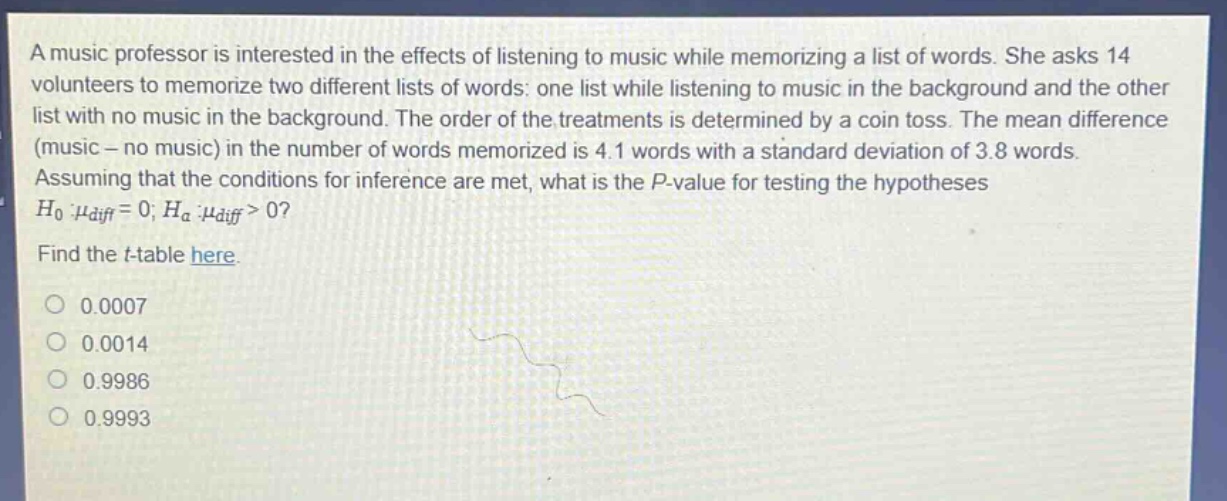
a music professor is interested in the effects of listening to music while memorizing a list of words. she asks 14 volunteers to memorize two different lists of words: one list while listening to music in the background and the other list with no music in the background. the order of the treatments is determined by a coin toss. the mean difference (music - no music) in the number of words memorized is 4.1 words with a standard deviation of 3.8 words. assuming that the conditions for inference are met, what is the p - value for testing the hypotheses $h_0:mu_{diff}=0;h_a:mu_{diff}>0$? find the t - table here. 0.0007 0.0014 0.9986 0.9993
Answer
Explanation:
Step1: Calculate degrees of freedom
The sample size $n = 14$. Degrees of freedom $df=n - 1=14 - 1 = 13$.
Step2: Calculate the t - statistic
The formula for the t - statistic in a paired - samples t - test is $t=\frac{\bar{d}-\mu_d}{s_d/\sqrt{n}}$. Here, $\bar{d}=4.1$, $\mu_d = 0$ (from the null hypothesis $H_0:\mu_{dif}=0$), $s_d = 3.8$, and $n = 14$. So $t=\frac{4.1-0}{3.8/\sqrt{14}}\approx\frac{4.1}{3.8/3.742}\approx\frac{4.1}{1.015}\approx4.04$.
Step3: Find the P - value
We are conducting a one - tailed test ($H_a:\mu_{dif}>0$) with $df = 13$ and $t\approx4.04$. Looking up in the t - table or using a calculator with a t - distribution function (e.g., tcdf in a TI - 84 Plus: tcdf$(4.04,\infty,13)$), we find that the P - value is very small. For a t - value of 4.04 with $df = 13$, the P - value is approximately $0.0007$.
Answer:
0.0007