myra uses an inverse variation function to model the data for the ordered pairs below.\n(2, 30), (3, 20)…
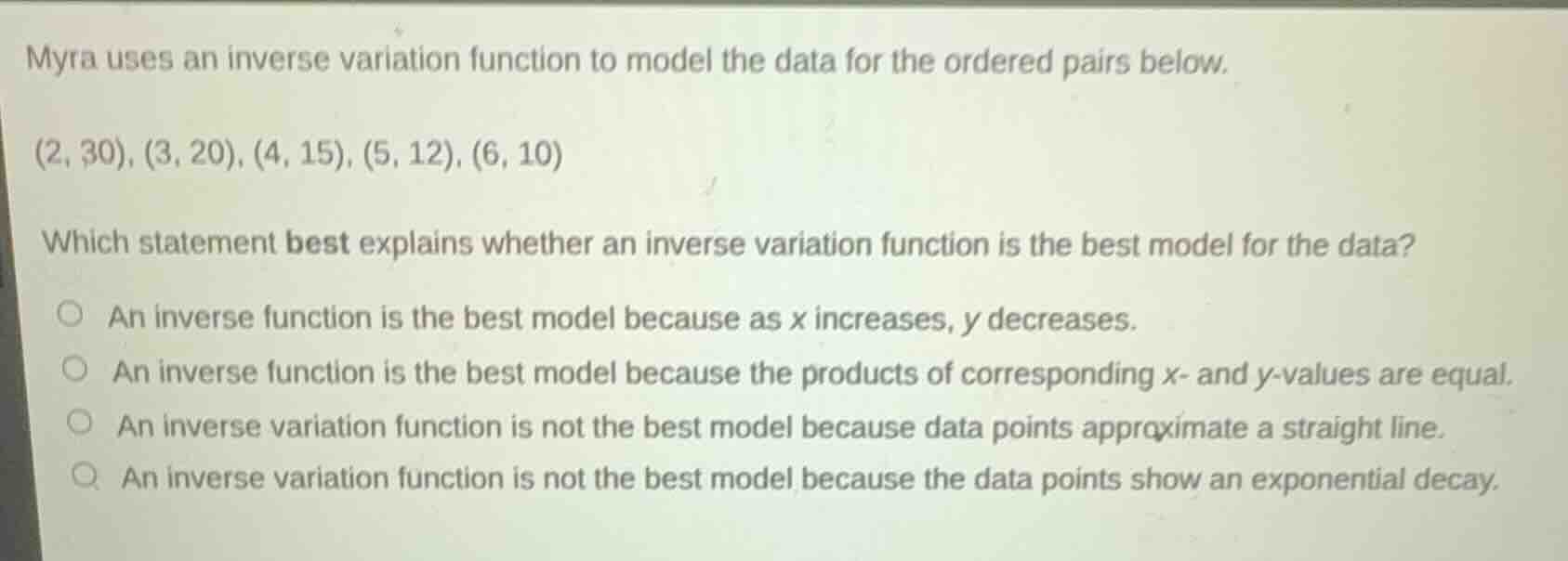
myra uses an inverse variation function to model the data for the ordered pairs below.\n(2, 30), (3, 20), (4, 15), (5, 12), (6, 10)\nwhich statement best explains whether an inverse variation function is the best model for the data?\nan inverse function is the best model because as x increases, y decreases.\nan inverse function is the best model because the products of corresponding x- and y-values are equal.\nan inverse variation function is not the best model because data points approximate a straight line.\nan inverse variation function is not the best model because the data points show an exponential decay.
Answer
Explanation:
Step1: Recall inverse variation rule
For inverse variation, $x \times y = k$ (constant $k$).
Step2: Calculate $x \times y$ for each pair
$2 \times 30 = 60$, $3 \times 20 = 60$, $4 \times 15 = 60$, $5 \times 12 = 60$, $6 \times 10 = 60$
Step3: Evaluate each option
First option is insufficient (decrease alone doesn't confirm inverse variation). Third/fourth are false (data doesn't fit line/exponential decay). Second matches our calculation.
Answer:
An inverse function is the best model because the products of corresponding x- and y-values are equal.