2. naomi has three six - sided dice. two of them are fair six - sided dice, for which there is an equal…
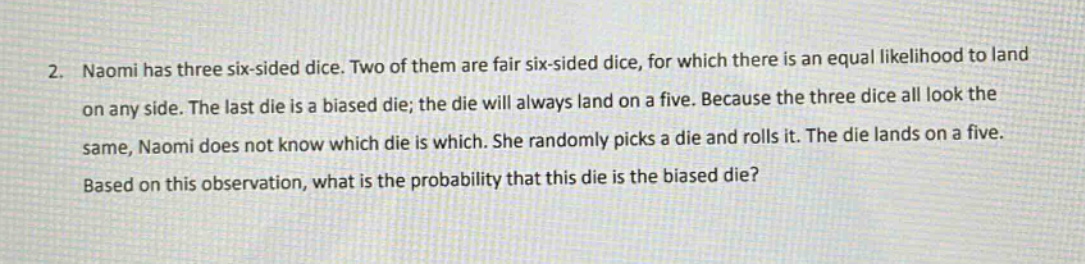
2. naomi has three six - sided dice. two of them are fair six - sided dice, for which there is an equal likelihood to land on any side. the last die is a biased die; the die will always land on a five. because the three dice all look the same, naomi does not know which die is which. she randomly picks a die and rolls it. the die lands on a five. based on this observation, what is the probability that this die is the biased die?
Answer
Explanation:
Step1: Define events
Let $B$ be the event of picking the biased die, and $F$ be the event of rolling a five.
Step2: Calculate prior probabilities
The probability of picking the biased die $P(B)=\frac{1}{3}$, and the probability of picking a fair - die $P(\overline{B})=\frac{2}{3}$.
Step3: Calculate conditional probabilities
The probability of rolling a five given that the die is biased $P(F|B) = 1$. The probability of rolling a five given that the die is fair $P(F|\overline{B})=\frac{1}{6}$.
Step4: Apply Bayes' theorem
By Bayes' theorem $P(B|F)=\frac{P(F|B)P(B)}{P(F|B)P(B)+P(F|\overline{B})P(\overline{B})}$. Substitute the values: [ \begin{align*} P(B|F)&=\frac{1\times\frac{1}{3}}{1\times\frac{1}{3}+\frac{1}{6}\times\frac{2}{3}}\ &=\frac{\frac{1}{3}}{\frac{1}{3}+\frac{1}{9}}\ &=\frac{\frac{1}{3}}{\frac{3 + 1}{9}}\ &=\frac{\frac{1}{3}}{\frac{4}{9}}\ &=\frac{1}{3}\times\frac{9}{4}\ &=\frac{3}{4} \end{align*} ]
Answer:
$\frac{3}{4}$