the national assessment of educational progress (naep) includes a mathematics test for eighth - grade…
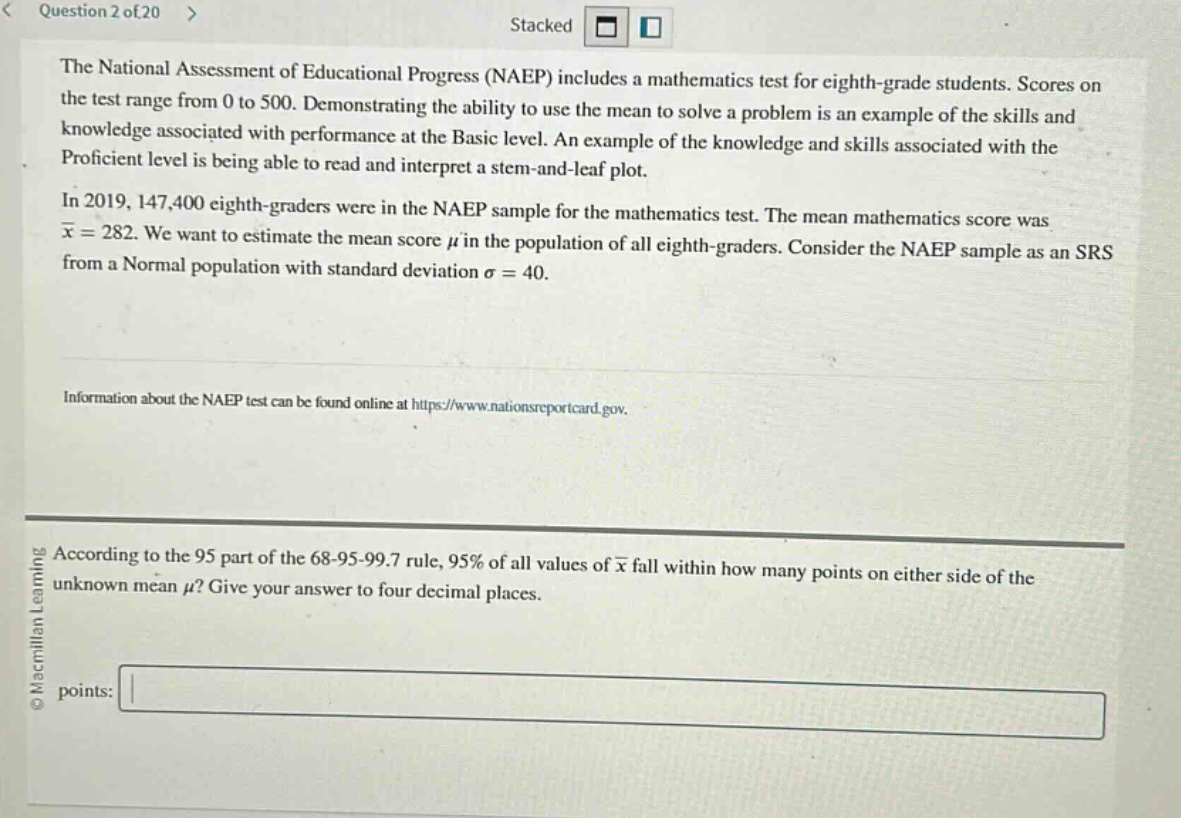
the national assessment of educational progress (naep) includes a mathematics test for eighth - grade students. scores on the test range from 0 to 500. demonstrating the ability to use the mean to solve a problem is an example of the skills and knowledge associated with performance at the basic level. an example of the knowledge and skills associated with the proficient level is being able to read and interpret a stem - and - leaf plot. in 2019, 147,400 eighth - graders were in the naep sample for the mathematics test. the mean mathematics score was $\bar{x}=282$. we want to estimate the mean score $mu$ in the population of all eighth - graders. consider the naep sample as an srs from a normal population with standard deviation $sigma = 40$. information about the naep test can be found online at https://www.nationsreportcard.gov. according to the 95 part of the 68 - 95 - 99.7 rule, 95% of all values of $\bar{x}$ fall within how many points on either side of the unknown mean $mu$? give your answer to four decimal places. points:
Answer
Explanation:
Step1: Recall the 68 - 95 - 99.7 rule
For a normal distribution, 95% of the data falls within 2 standard deviations of the mean.
Step2: Calculate the margin of error
The standard deviation of the sampling distribution of the sample mean (also known as the standard error) for a sample of size $n$ from a population with standard deviation $\sigma$ is $\sigma_{\bar{x}}=\frac{\sigma}{\sqrt{n}}$. Here, we are not given the sample - size $n$ in the part of the question related to the 95% rule application. But for the 95% part of the 68 - 95 - 99.7 rule, the number of standard deviations from the mean is $z = 2$. The value we want is the margin of error $E=z\times\sigma_{\bar{x}}$. Since we are not using the sample - size for the 68 - 95 - 99.7 rule in the context of the population standard deviation, the number of points within which 95% of all values of $\bar{x}$ fall on either side of the unknown mean $\mu$ is $2\sigma$. Given $\sigma = 40$, we calculate $2\times40$. $2\times40=80.0000$
Answer:
$80.0000$