6. a number 1 - 45 is chosen at random. what is the probability that is a perfect square or a multiple of…
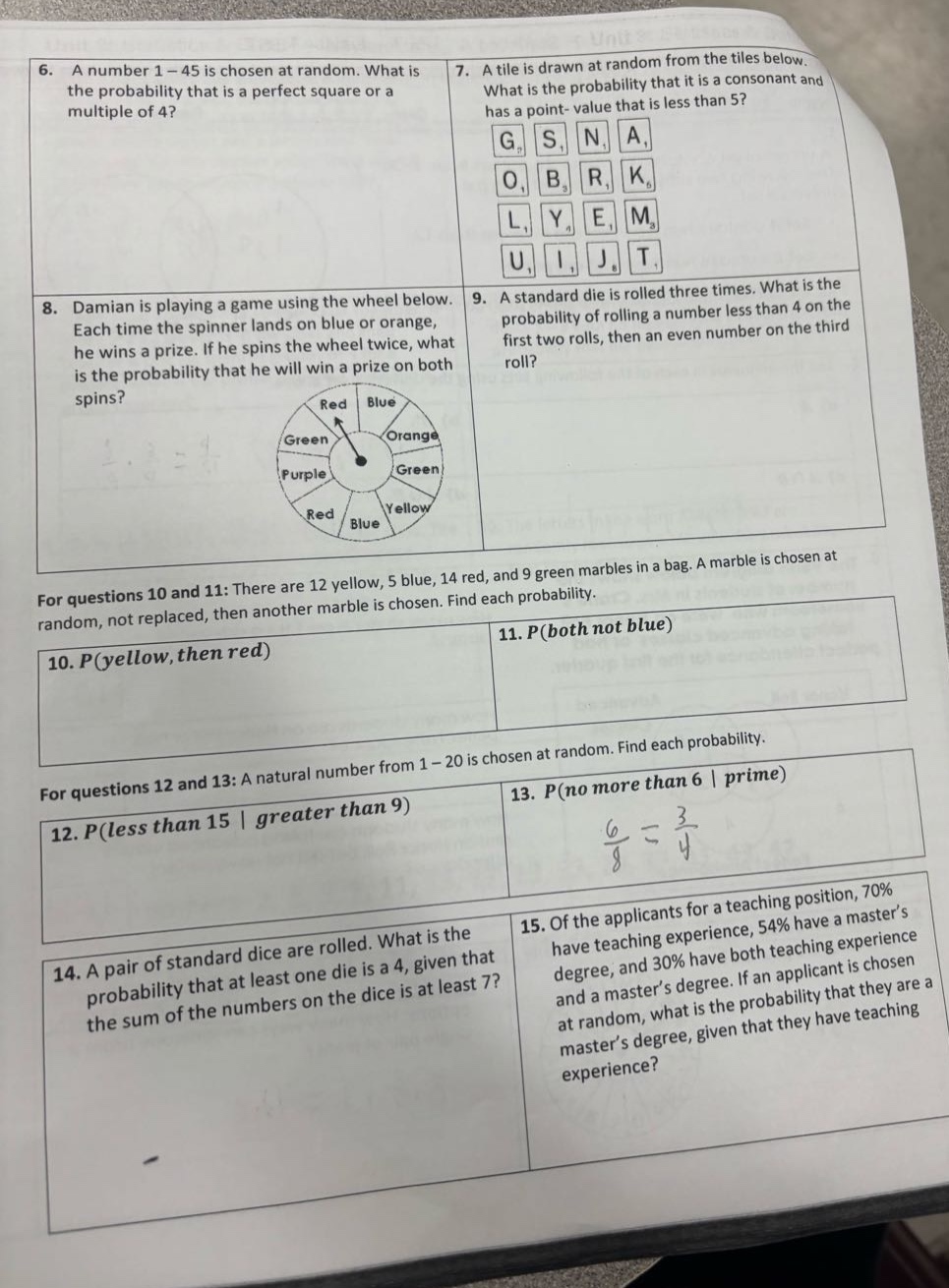
6. a number 1 - 45 is chosen at random. what is the probability that is a perfect square or a multiple of 4?\n7. a tile is drawn at random from the tiles below. what is the probability that it is a consonant and has a point - value that is less than 5?\n8. damian is playing a game using the wheel below. each time the spinner lands on blue or orange, he wins a prize. if he spins the wheel twice, what is the probability that he will win a prize on both spins?\n9. a standard die is rolled three times. what is the probability of rolling a number less than 4 on the first two rolls, then an even number on the third roll?\nfor questions 10 and 11: there are 12 yellow, 5 blue, 14 red, and 9 green marbles in a bag. a marble is chosen at random, not replaced, then another marble is chosen. find each probability.\n10. p(yellow, then red)\n11. p(both not blue)\nfor questions 12 and 13: a natural number from 1 - 20 is chosen at random. find each probability.\n12. p(less than 15 | greater than 9)\n13. p(no more than 6 | prime)\n14. a pair of standard dice are rolled. what is the probability that at least one die is a 4, given that the sum of the numbers on the dice is at least 7?\n15. of the applicants for a teaching position, 70% have teaching experience, 54% have a master’s degree, and 30% have both teaching experience and a master’s degree. if an applicant is chosen at random, what is the probability that they are a master’s degree, given that they have teaching experience?
Answer
6.
Explanation:
Step1: Find perfect - squares and multiples of 4
Perfect squares from 1 - 45 are 1, 4, 9, 16, 25, 36. Multiples of 4 from 1 - 45 are 4, 8, 12, 16, 20, 24, 28, 32, 36, 40, 44. The set of perfect - squares or multiples of 4 is {1, 4, 8, 9, 12, 16, 20, 24, 25, 28, 32, 36, 40, 44}, and $n = 14$.
Step2: Calculate probability
The total number of outcomes is $N=45$. The probability $P=\frac{n}{N}=\frac{14}{45}$.
Answer:
$\frac{14}{45}$
7.
Explanation:
Step1: Identify consonants with point - value less than 5
Consonants with point - value less than 5 are G (2 points), S (1 point), N (1 point), B (3 points), R (1 point), K (5 points), L (1 point), Y (4 points), M (3 points), T (1 point). The favorable tiles are G, S, N, B, R, L, Y, M, T, and $n = 9$.
Step2: Calculate probability
The total number of tiles is $N = 20$. The probability $P=\frac{n}{N}=\frac{9}{20}$.
Answer:
$\frac{9}{20}$
8.
Explanation:
Step1: Find the probability of winning on one spin
The wheel has 8 sections, and the favorable sections (blue or orange) are 3. So the probability of winning on one spin $p=\frac{3}{8}$.
Step2: Calculate the probability of winning on both spins
Since the spins are independent events, the probability of winning on both spins is $P = p\times p=\frac{3}{8}\times\frac{3}{8}=\frac{9}{64}$.
Answer:
$\frac{9}{64}$
9.
Explanation:
Step1: Find the probability of rolling a number less than 4 on the first two rolls
The probability of rolling a number less than 4 (1, 2, 3) on a single roll of a die is $\frac{3}{6}=\frac{1}{2}$. Since the first two rolls are independent, the probability of rolling a number less than 4 on both is $\frac{1}{2}\times\frac{1}{2}=\frac{1}{4}$.
Step2: Find the probability of rolling an even number on the third roll
The probability of rolling an even number (2, 4, 6) on a die is $\frac{3}{6}=\frac{1}{2}$.
Step3: Calculate the overall probability
Since the three rolls are independent events, the overall probability is $\frac{1}{4}\times\frac{1}{2}=\frac{1}{8}$.
Answer:
$\frac{1}{8}$
10.
Explanation:
Step1: Calculate the probability of choosing a yellow marble first
The total number of marbles is $12 + 5+14 + 9=40$. The probability of choosing a yellow marble first is $P_1=\frac{12}{40}=\frac{3}{10}$.
Step2: Calculate the probability of choosing a red marble second
After choosing a yellow marble, there are 39 marbles left. The probability of choosing a red marble second is $P_2=\frac{14}{39}$.
Step3: Calculate the combined probability
Since these are dependent events, the probability of choosing a yellow then a red marble is $P = P_1\times P_2=\frac{3}{10}\times\frac{14}{39}=\frac{7}{65}$.
Answer:
$\frac{7}{65}$
11.
Explanation:
Step1: Calculate the probability of not choosing a blue marble first
The probability of not choosing a blue marble first is $\frac{40 - 5}{40}=\frac{35}{40}=\frac{7}{8}$.
Step2: Calculate the probability of not choosing a blue marble second
After not choosing a blue marble first, there are 39 marbles left, and 34 non - blue marbles. The probability of not choosing a blue marble second is $\frac{34}{39}$.
Step3: Calculate the combined probability
The probability of both not being blue is $P=\frac{7}{8}\times\frac{34}{39}=\frac{119}{156}$.
Answer:
$\frac{119}{156}$
12.
Explanation:
Step1: Find the numbers greater than 9 and less than 15
Numbers greater than 9 and less than 15 from 1 - 20 are 10, 11, 12, 13, 14. So $n = 5$.
Step2: Find the numbers greater than 9
Numbers greater than 9 from 1 - 20 are 10, 11, 12, 13, 14, 15, 16, 17, 18, 19, 20. So $N = 11$.
Step3: Calculate the probability
The probability $P=\frac{n}{N}=\frac{5}{11}$.
Answer:
$\frac{5}{11}$
13.
Explanation:
Step1: Find prime numbers from 1 - 20
Prime numbers from 1 - 20 are 2, 3, 5, 7, 11, 13, 17, 19. So $N = 8$.
Step2: Find prime numbers no more than 6
Prime numbers no more than 6 are 2, 3, 5. So $n = 3$.
Step3: Calculate the probability
The probability $P=\frac{n}{N}=\frac{3}{8}$.
Answer:
$\frac{3}{8}$
14.
Explanation:
Step1: Find the number of pairs of dice with sum at least 7
The total number of outcomes when rolling two dice is $n(S)=6\times6 = 36$. The pairs with sum at least 7 are: (1,6), (2,5), (2,6), (3,4), (3,5), (3,6), (4,3), (4,4), (4,5), (4,6), (5,2), (5,3), (5,4), (5,5), (5,6), (6,1), (6,2), (6,3), (6,4), (6,5), (6,6), $n(A)=21$.
Step2: Find the number of pairs with sum at least 7 and at least one 4
The pairs are: (3,4), (4,3), (4,4), (4,5), (4,6), (5,4), (6,4), $n(A\cap B)=7$.
Step3: Calculate the conditional probability
The conditional probability $P=\frac{n(A\cap B)}{n(A)}=\frac{7}{21}=\frac{1}{3}$.
Answer:
$\frac{1}{3}$
15.
Explanation:
Step1: Use the formula for conditional probability
The formula for conditional probability is $P(A|B)=\frac{P(A\cap B)}{P(B)}$. Let $A$ be the event of having a master's degree and $B$ be the event of having teaching experience. We know that $P(A\cap B)=0.3$ and $P(B)=0.54$.
Step2: Calculate the conditional probability
$P(A|B)=\frac{0.3}{0.54}=\frac{5}{9}$.
Answer:
$\frac{5}{9}$