the number of coyotes, n, reported near a new housing development after t years is given in the table. which…
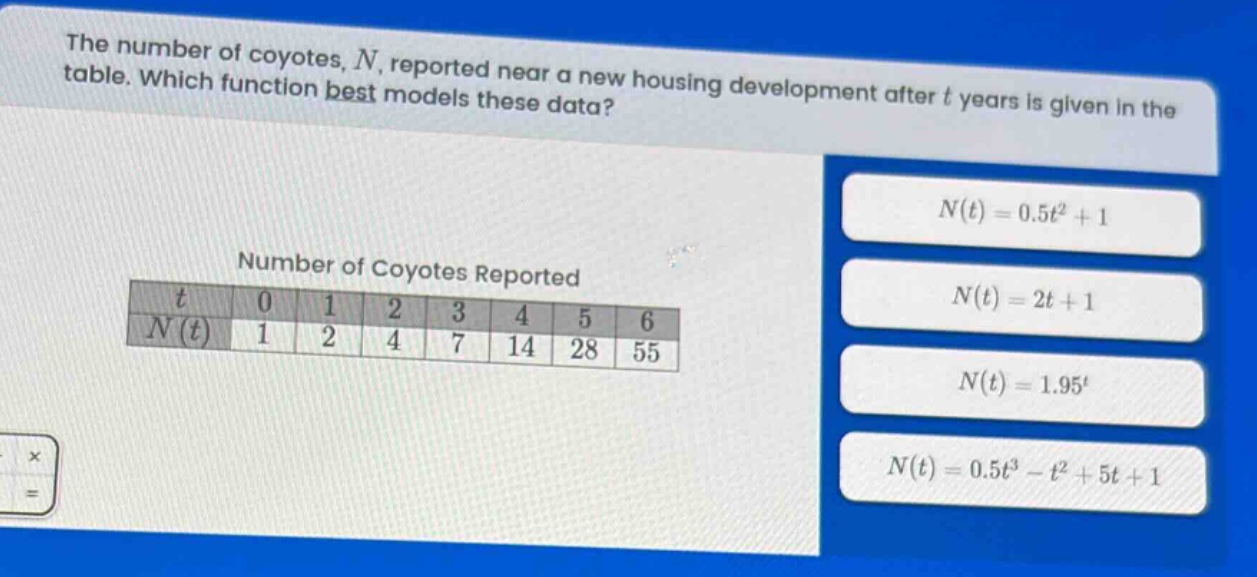
the number of coyotes, n, reported near a new housing development after t years is given in the table. which function best models these data?\nnumber of coyotes reported\n| t | 0 | 1 | 2 | 3 | 4 | 5 | 6 |\n| n(t) | 1 | 2 | 4 | 7 | 14 | 28 | 55 |\nn(t)=0.5t² + 1\nn(t)=2t + 1\nn(t)=1.95ᵗ\nn(t)=0.5t³ - t² + 5t + 1
Answer
Explanation:
Step1: Test (t = 0) for each function
For (N(t)=0.5t^{2}+1), when (t = 0), (N(0)=0.5\times0^{2}+1=1). For (N(t)=2t + 1), when (t = 0), (N(0)=2\times0+1=1). For (N(t)=1.95^{t}), when (t = 0), (N(0)=1.95^{0}=1). For (N(t)=0.5t^{3}-t^{2}+5t + 1), when (t = 0), (N(0)=0.5\times0^{3}-0^{2}+5\times0 + 1=1). All functions pass the (t = 0) - test.
Step2: Test (t = 1) for each function
For (N(t)=0.5t^{2}+1), when (t = 1), (N(1)=0.5\times1^{2}+1=0.5 + 1=1.5\neq2). For (N(t)=2t + 1), when (t = 1), (N(1)=2\times1+1=3\neq2). For (N(t)=1.95^{t}), when (t = 1), (N(1)=1.95\neq2). For (N(t)=0.5t^{3}-t^{2}+5t + 1), when (t = 1), (N(1)=0.5\times1^{3}-1^{2}+5\times1 + 1=0.5-1 + 5+1=5.5\neq2).
Step3: Test (t = 2) for each function
For (N(t)=0.5t^{2}+1), when (t = 2), (N(2)=0.5\times2^{2}+1=0.5\times4 + 1=2 + 1=3\neq4). For (N(t)=2t + 1), when (t = 2), (N(2)=2\times2+1=5\neq4). For (N(t)=1.95^{t}), when (t = 2), (N(2)=1.95^{2}=3.8025\approx4). For (N(t)=0.5t^{3}-t^{2}+5t + 1), when (t = 2), (N(2)=0.5\times2^{3}-2^{2}+5\times2 + 1=0.5\times8-4 + 10+1=4-4 + 10+1=11\neq4).
Step4: Test (t = 3) for (N(t)=1.95^{t})
When (t = 3), (N(3)=1.95^{3}=1.95\times1.95\times1.95 = 7.414875\approx7).
Step5: Test (t = 4) for (N(t)=1.95^{t})
When (t = 4), (N(4)=1.95^{4}=1.95\times1.95\times1.95\times1.95\approx14.45\approx14).
Step6: Test (t = 5) for (N(t)=1.95^{t})
When (t = 5), (N(5)=1.95^{5}=1.95\times1.95\times1.95\times1.95\times1.95\approx28.18\approx28).
Step7: Test (t = 6) for (N(t)=1.95^{t})
When (t = 6), (N(6)=1.95^{6}=1.95\times1.95\times1.95\times1.95\times1.95\times1.95\approx54.95\approx55).
Answer:
(N(t)=1.95^{t})