a number cube has faces numbered 1 to 6. what is true about rolling the number cube one time? select three…
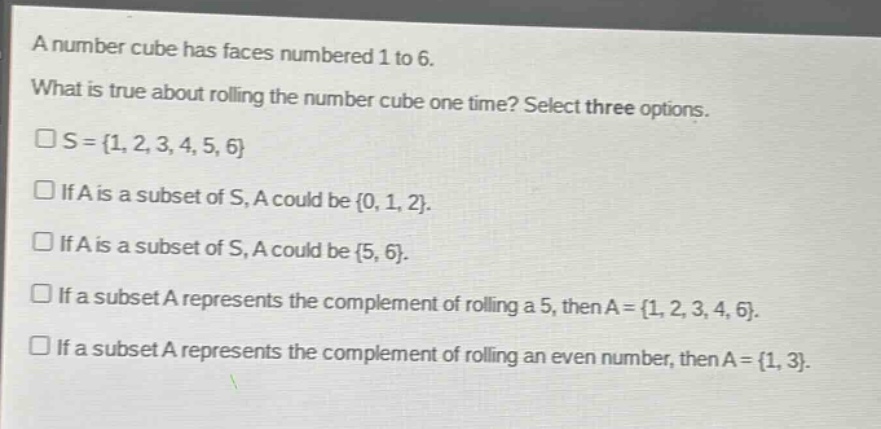
a number cube has faces numbered 1 to 6. what is true about rolling the number cube one time? select three options. \n□s = {1, 2, 3, 4, 5, 6}\n□ if a is a subset of s, a could be {0, 1, 2}.\n□ if a is a subset of s, a could be {5, 6}.\n□ if a subset a represents the complement of rolling a 5, then a = {1, 2, 3, 4, 6}.\n□ if a subset a represents the complement of rolling an even number, then a = {1, 3}.
Answer
Explanation:
Step1: Define sample - space
The sample - space S of rolling a number cube numbered 1 to 6 is the set of all possible outcomes. So, S = {1, 2, 3, 4, 5, 6}.
Step2: Analyze subset conditions
A subset of S must contain only elements from S. Since 0 is not in S, A = {0, 1, 2} cannot be a subset of S. But A = {5, 6} is a subset of S as 5 and 6 are in S.
Step3: Find complement sets
The complement of an event is all the outcomes in the sample - space that are not in the event. The complement of rolling a 5 is all the numbers on the cube except 5, so A = {1, 2, 3, 4, 6}. The complement of rolling an even number (2, 4, 6) is the set of odd numbers {1, 3, 5}, not {1, 3}.
Answer:
S = {1, 2, 3, 4, 5, 6}; If A is a subset of S, A could be {5, 6}; If a subset A represents the complement of rolling a 5, then A = {1, 2, 3, 4, 6}