a number cube labeled 1 through 6 is rolled three times. what is the probability that the first roll is a 1…
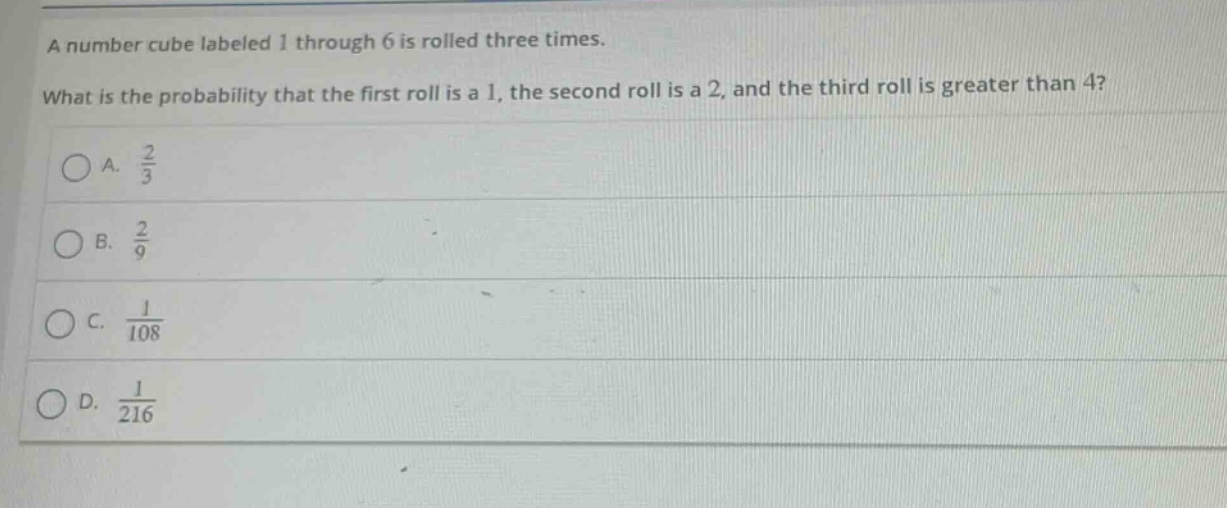
a number cube labeled 1 through 6 is rolled three times. what is the probability that the first roll is a 1, the second roll is a 2, and the third roll is greater than 4?\na. $\frac{2}{3}$\nb. $\frac{2}{9}$\nc. $\frac{1}{108}$\nd. $\frac{1}{216}$
Answer
Explanation:
Step1: Probability of first - roll
The probability of rolling a 1 on a fair six - sided die is $\frac{1}{6}$ since there is 1 favorable outcome (rolling a 1) out of 6 possible outcomes.
Step2: Probability of second - roll
The probability of rolling a 2 on a fair six - sided die is $\frac{1}{6}$ since there is 1 favorable outcome (rolling a 2) out of 6 possible outcomes.
Step3: Probability of third - roll
The numbers greater than 4 on a six - sided die are 5 and 6. So there are 2 favorable outcomes out of 6 possible outcomes. The probability of rolling a number greater than 4 is $\frac{2}{6}=\frac{1}{3}$.
Step4: Use the multiplication rule for independent events
Since the rolls of the die are independent events, the probability of all three events occurring is the product of their individual probabilities. So $P=\frac{1}{6}\times\frac{1}{6}\times\frac{1}{3}=\frac{1}{108}$.
Answer:
C. $\frac{1}{108}$