a number cube was rolled as part of an experiment. the results are displayed in the table below.\n| number |…
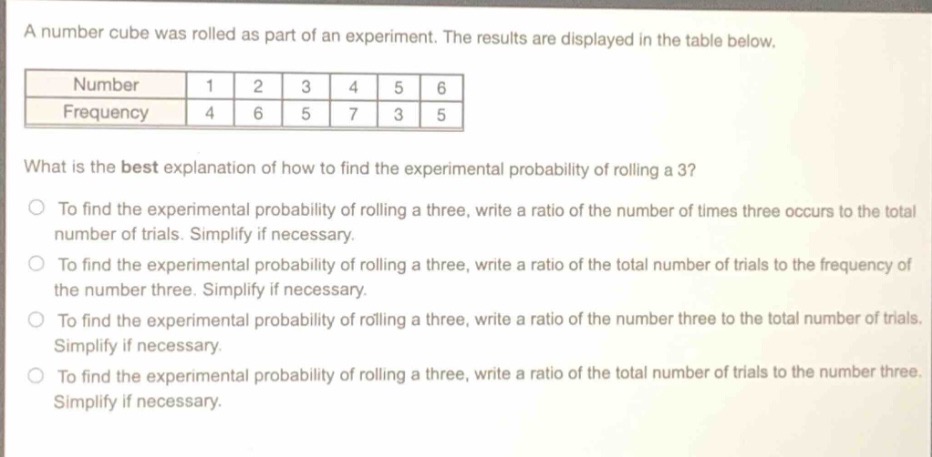
a number cube was rolled as part of an experiment. the results are displayed in the table below.\n| number | 1 | 2 | 3 | 4 | 5 | 6 |\n| frequency | 4 | 6 | 5 | 7 | 3 | 5 |\nwhat is the best explanation of how to find the experimental probability of rolling a 3?\nto find the experimental probability of rolling a three, write a ratio of the number of times three occurs to the total number of trials. simplify if necessary.\nto find the experimental probability of rolling a three, write a ratio of the total number of trials to the frequency of the number three. simplify if necessary.\nto find the experimental probability of rolling a three, write a ratio of the number three to the total number of trials. simplify if necessary.\nto find the experimental probability of rolling a three, write a ratio of the total number of trials to the number three. simplify if necessary.
Answer
Brief Explanations:
Experimental probability is calculated as the ratio of the number of times an event occurs to the total number of trials. For rolling a 3 on a number - cube, we need to take the frequency of 3 (the number of times 3 occurs) and divide it by the total number of trials.
Answer:
To find the experimental probability of rolling a three, write a ratio of the number of times three occurs to the total number of trials. Simplify if necessary.