a nutritionist believes that 10% of teenagers eat cereal for breakfast. to investigate this claim, she…
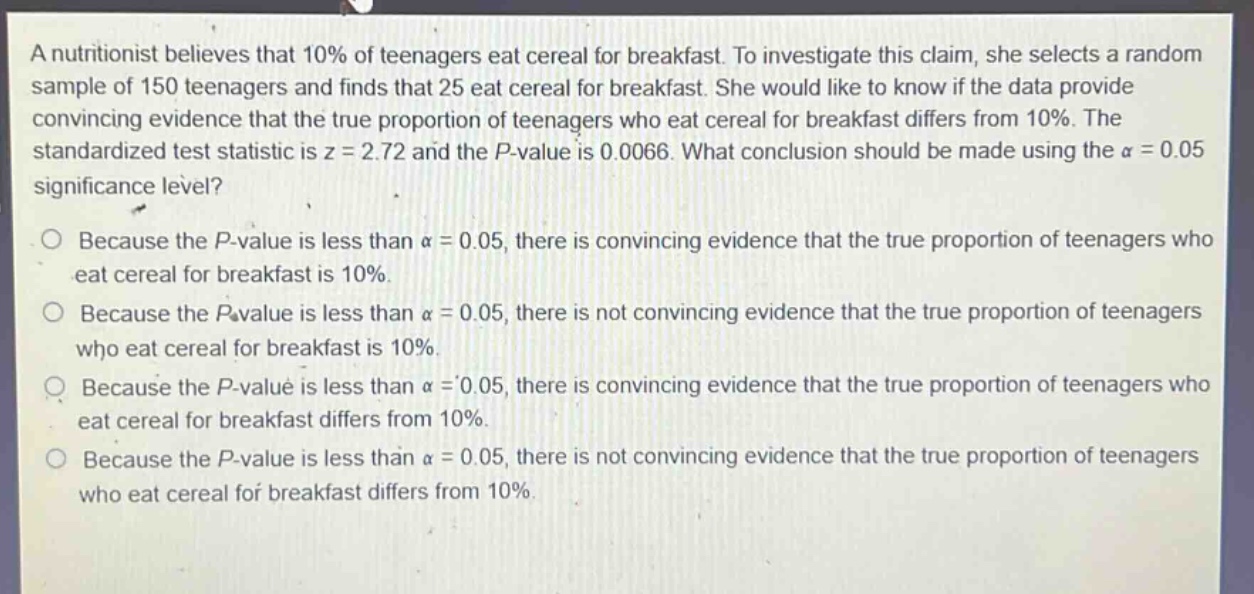
a nutritionist believes that 10% of teenagers eat cereal for breakfast. to investigate this claim, she selects a random sample of 150 teenagers and finds that 25 eat cereal for breakfast. she would like to know if the data provide convincing evidence that the true proportion of teenagers who eat cereal for breakfast differs from 10%. the standardized test statistic is z = 2.72 and the p - value is 0.0066. what conclusion should be made using the α = 0.05 significance level? because the p - value is less than α = 0.05, there is convincing evidence that the true proportion of teenagers who eat cereal for breakfast is 10%. because the p - value is less than α = 0.05, there is not convincing evidence that the true proportion of teenagers who eat cereal for breakfast is 10%. because the p - value is less than α = 0.05, there is convincing evidence that the true proportion of teenagers who eat cereal for breakfast differs from 10%. because the p - value is less than α = 0.05, there is not convincing evidence that the true proportion of teenagers who eat cereal for breakfast differs from 10%.
Answer
Explanation:
Step1: Recall hypothesis - testing rule
In hypothesis - testing, if $P - value<\alpha$, we reject the null hypothesis.
Step2: Identify null and alternative hypotheses
The null hypothesis $H_0:p = 0.10$ and the alternative hypothesis $H_a:p\neq0.10$.
Step3: Compare P - value and $\alpha$
Given $P - value = 0.0066$ and $\alpha=0.05$. Since $0.0066<0.05$, we reject the null hypothesis.
Answer:
Because the $P$-value is less than $\alpha = 0.05$, there is convincing evidence that the true proportion of teenagers who eat cereal for breakfast differs from $10%$.