observations of the rocks\ngroup number of rocks used average mass of rocks used (grams) texture of rocks…
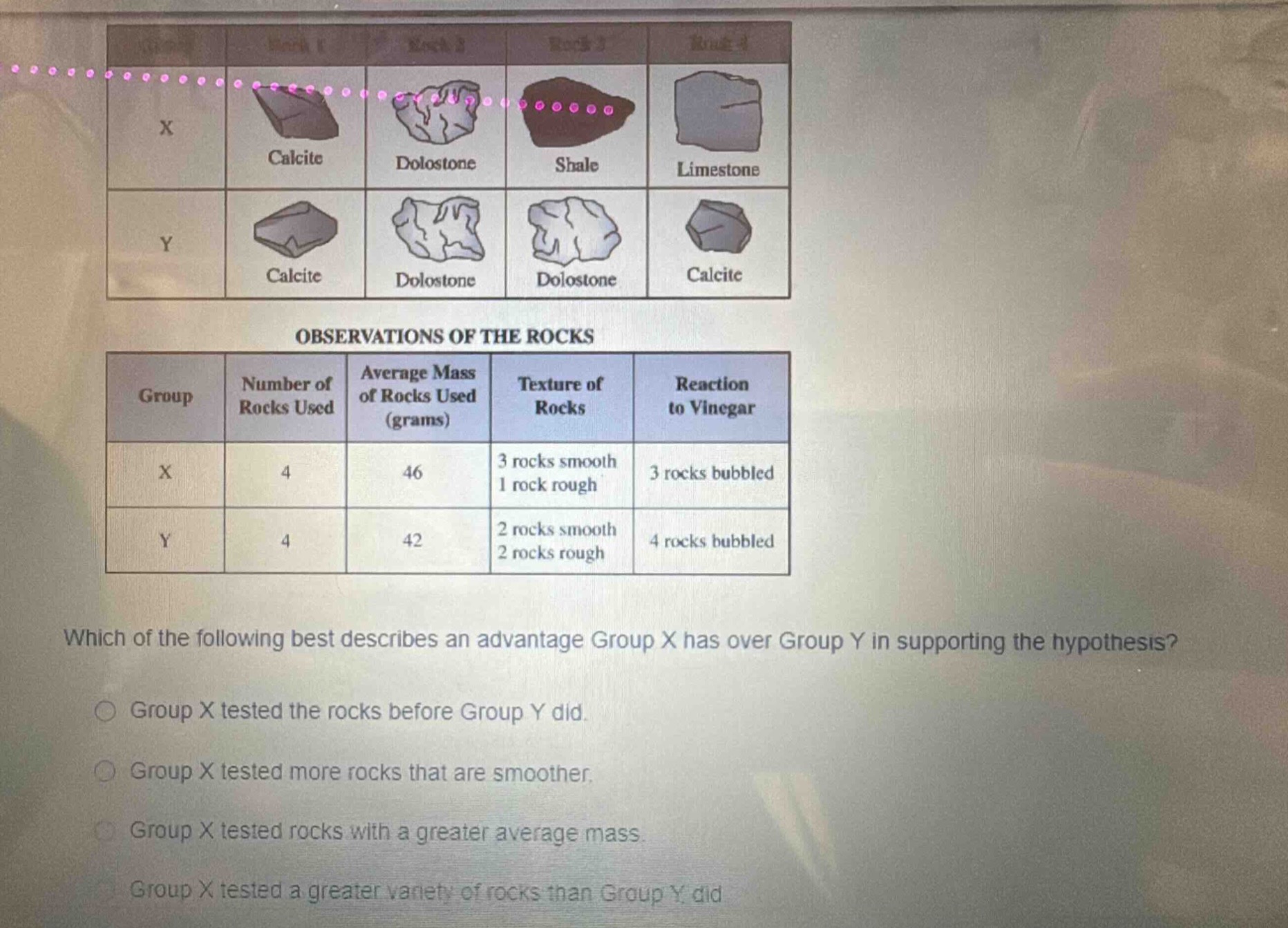
observations of the rocks\ngroup number of rocks used average mass of rocks used (grams) texture of rocks reaction to vinegar\nx 4 46 3 rocks smooth 1 rock rough 3 rocks bubbled\ny 4 42 2 rocks smooth 2 rocks rough 4 rocks bubbled\nwhich of the following best describes an advantage group x has over group y in supporting the hypothesis?\ngroup x tested the rocks before group y did.\ngroup x tested more rocks that are smoother.\ngroup x tested rocks with a greater average mass.\ngroup x tested a greater variety of rocks than group y did
Answer
Brief Explanations:
The question asks for an advantage Group X has over Group Y in supporting a hypothesis, based on the provided experimental setup and observations. Comparing the rocks used by each group: Group X used four distinct types of rocks: Calcite, Dolostone, Shale, and Limestone. Group Y used four rocks, but only two distinct types: Calcite (twice) and Dolostone (twice). Testing a wider range of different materials (greater variety) generally provides stronger support for a hypothesis because it shows the findings are applicable across different types, rather than potentially being specific to only one or two types. While other differences exist (texture distribution, average mass), the variety of rock types tested is a fundamental aspect of experimental design strength when aiming for generalizable conclusions. Group X's use of four different rock types represents a greater variety compared to Group Y's use of only two different types.
Answer:
Group X tested a greater variety of rocks than Group Y did.