old faithful is a geyser in yellowstone national park. the table shows the approximate length of an eruption…
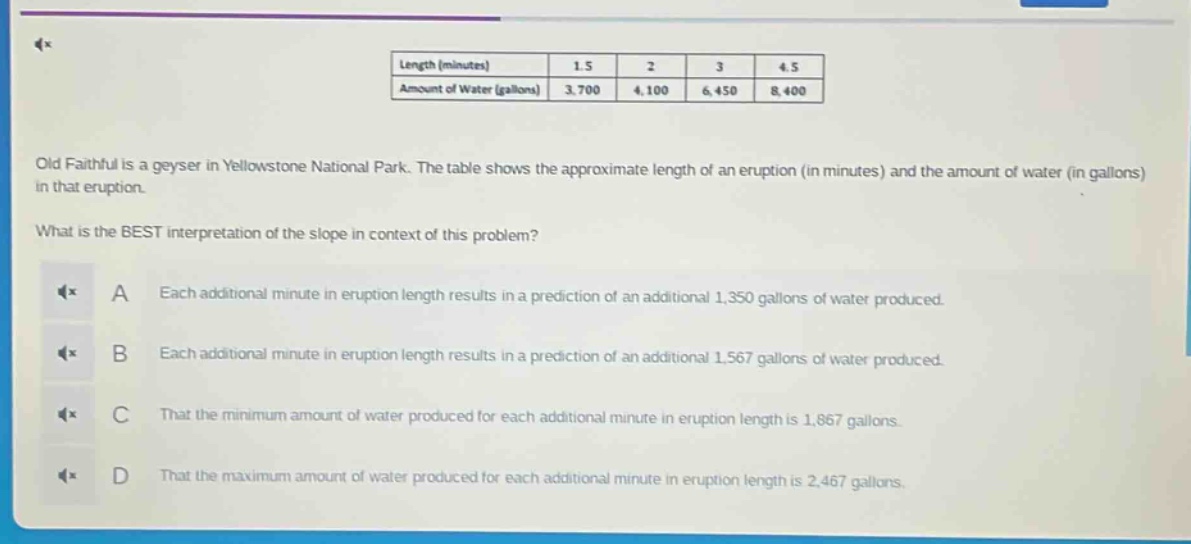
old faithful is a geyser in yellowstone national park. the table shows the approximate length of an eruption (in minutes) and the amount of water (in gallons) in that eruption. what is the best interpretation of the slope in context of this problem? a each additional minute in eruption length results in a prediction of an additional 1,350 gallons of water produced. b each additional minute in eruption length results in a prediction of an additional 1,567 gallons of water produced. c that the minimum amount of water produced for each additional minute in eruption length is 1,867 gallons. d that the maximum amount of water produced for each additional minute in eruption length is 2,467 gallons.
Answer
Explanation:
Step1: Recall slope formula
The slope formula is $m=\frac{y_2 - y_1}{x_2 - x_1}$, where $(x_1,y_1)$ and $(x_2,y_2)$ are two - points on the line. Let $x$ be the length of the eruption (in minutes) and $y$ be the amount of water (in gallons).
Step2: Choose two points
Let's take the first two points: $(x_1,y_1)=(1.5,3700)$ and $(x_2,y_2)=(2,4100)$.
Step3: Calculate the slope
$m=\frac{4100 - 3700}{2 - 1.5}=\frac{400}{0.5}=800$. Let's check with another pair of points, say $(x_1,y_1)=(2,4100)$ and $(x_2,y_2)=(3,6450)$. Then $m=\frac{6450 - 4100}{3 - 2}=\frac{2350}{1}=2350$. Let's use the first and the last points: $(x_1,y_1)=(1.5,3700)$ and $(x_2,y_2)=(4.5,8400)$. Then $m=\frac{8400 - 3700}{4.5 - 1.5}=\frac{4700}{3}\approx1567$. The slope represents the rate of change of the amount of water with respect to the length of the eruption. That is, for each additional minute in eruption length, the amount of water produced changes by the value of the slope.
Answer:
B. Each additional minute in eruption length results in a prediction of an additional 1,567 gallons of water produced.