one hundred students were surveyed and asked if they participate in band and if they play a sport. the table…
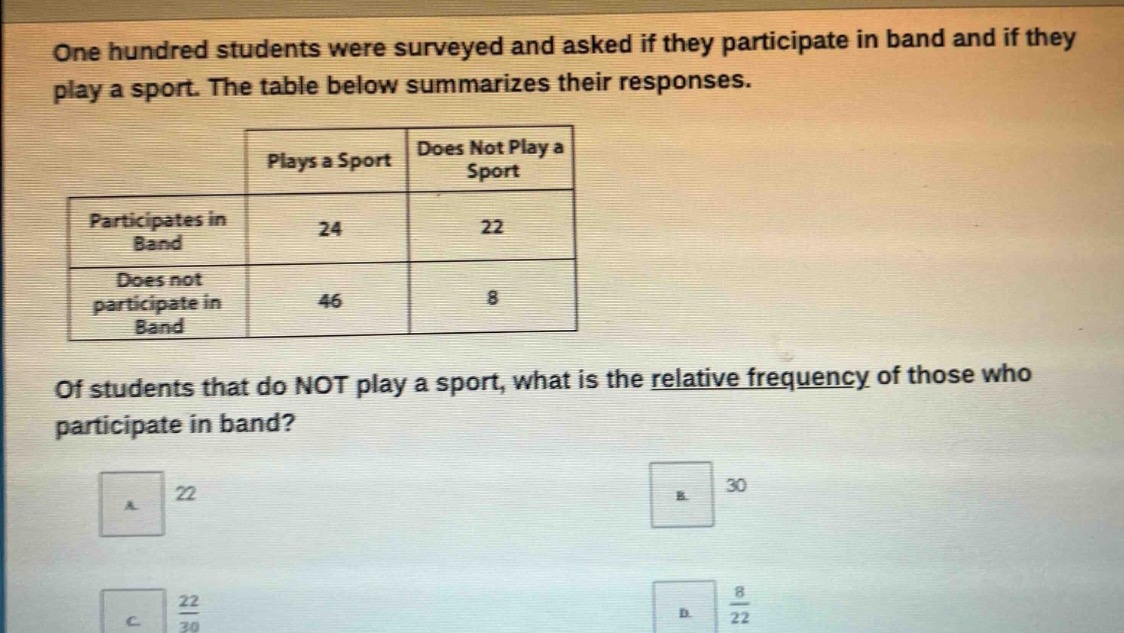
one hundred students were surveyed and asked if they participate in band and if they play a sport. the table below summarizes their responses.\n| |plays a sport|does not play a sport|\n|--|--|--|\n|participates in band|24|22|\n|does not participate in band|46|8|\nof students that do not play a sport, what is the relative frequency of those who participate in band?\na. 22\nb. 30\nc. $\frac{22}{30}$\nd. $\frac{8}{22}$
Answer
Explanation:
Step1: Find number of students who don't play a sport
Add the number of students who don't play a sport and participate in band and those who don't play a sport and don't participate in band. So, $22 + 8=30$.
Step2: Calculate relative - frequency
The relative frequency of students who participate in band among those who don't play a sport is the number of students who don't play a sport and participate in band divided by the total number of students who don't play a sport. That is $\frac{22}{30}$.
Answer:
C. $\frac{22}{30}$