an online test of english spelling looked at how well people spelled difficult words. the bar graph to the…
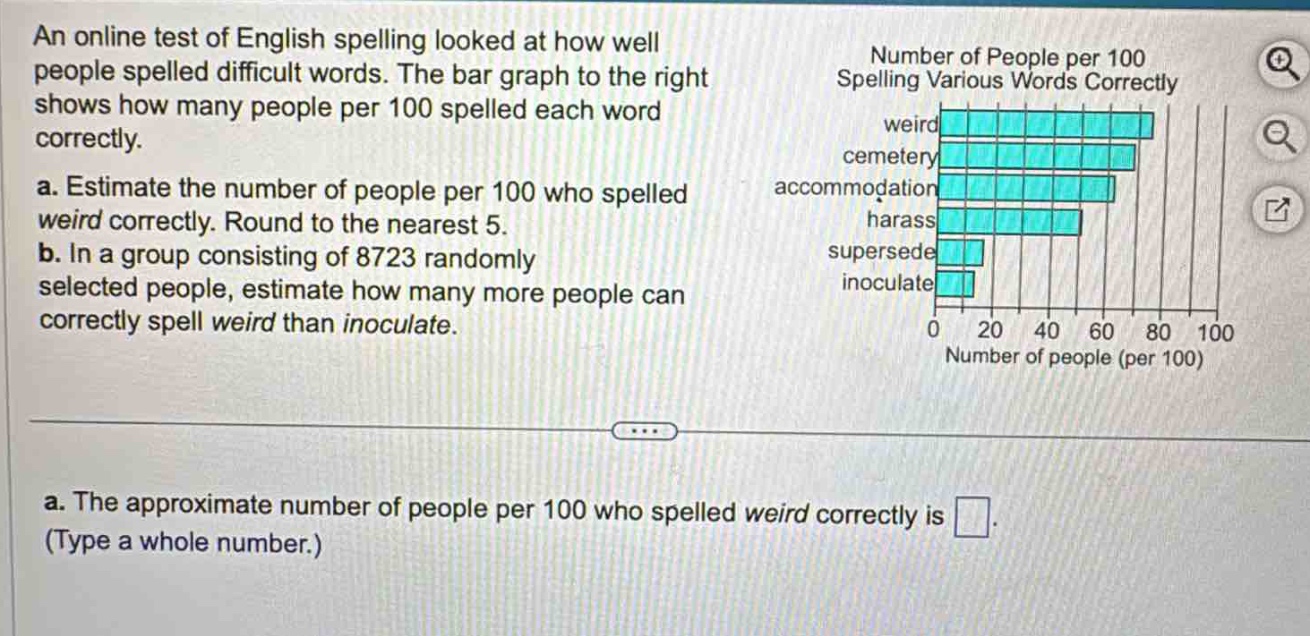
an online test of english spelling looked at how well people spelled difficult words. the bar graph to the right shows how many people per 100 spelled each word correctly.\na. estimate the number of people per 100 who spelled weird correctly. round to the nearest 5.\nb. in a group consisting of 8723 randomly selected people, estimate how many more people can correctly spell weird than inoculate.\na. the approximate number of people per 100 who spelled weird correctly is . (type a whole number.)
Answer
Explanation:
Step1: Estimate for part a
By looking at the bar - graph, the bar for "weird" is close to 85. Rounding to the nearest 5, the number of people per 100 who spelled "weird" correctly is 85.
Step2: Estimate number of people who spelled "inoculate" correctly
From the bar - graph, the number of people per 100 who spelled "inoculate" correctly is about 10.
Step3: Calculate the proportion difference
The difference in the proportion of people who spelled "weird" and "inoculate" correctly per 100 is $85 - 10=75$.
Step4: Calculate the number of people in the group
Let $x$ be the number of more people who can spell "weird" than "inoculate" in a group of 8723 people. We set up a proportion: $\frac{x}{8723}=\frac{75}{100}$. Then $x=\frac{75\times8723}{100}=6542.25\approx6540$.
Answer:
a. 85 b. 6540