the owner of a fitness watch would like to determine if the mean number of steps he takes per day differs…
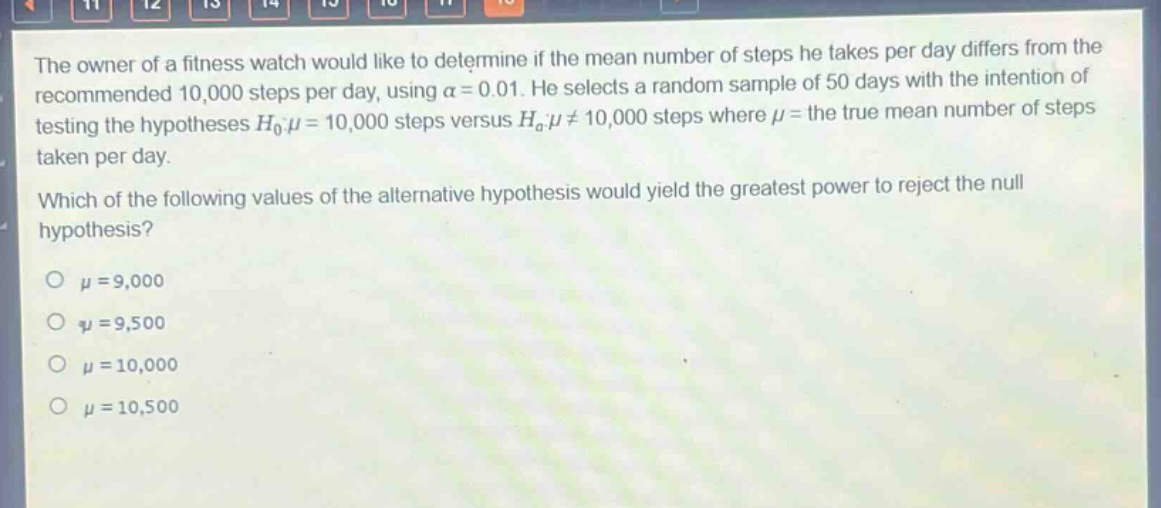
the owner of a fitness watch would like to determine if the mean number of steps he takes per day differs from the recommended 10,000 steps per day, using $alpha = 0.01$. he selects a random sample of 50 days with the intention of testing the hypotheses $h_0:mu = 10,000$ steps versus $h_a:mu\neq10,000$ steps where $mu$ = the true mean number of steps taken per day. which of the following values of the alternative hypothesis would yield the greatest power to reject the null hypothesis?\n$mu = 9,000$\n$mu = 9,500$\n$mu = 10,000$\n$mu = 10,500$
Answer
Explanation:
Step1: Understand power concept
Power is the probability of correctly rejecting the null hypothesis. The further the true - value of the parameter (in this case $\mu$) is from the null - hypothesized value, the greater the power.
Step2: Identify null - hypothesized value
The null hypothesis is $H_0:\mu = 10000$.
Step3: Calculate distances
Calculate the absolute differences between the values in the alternatives and the null - hypothesized value of $\mu = 10000$. For $\mu = 9000$, $|10000 - 9000|=1000$. For $\mu = 9500$, $|10000 - 9500| = 500$. For $\mu = 10000$, $|10000 - 10000|=0$. For $\mu = 10500$, $|10500 - 10000| = 500$. The largest absolute difference is 1000, which corresponds to $\mu = 9000$.
Answer:
$\mu = 9000$