the owner of a smart watch would like to estimate the mean number of steps they take per day. to do so, they…
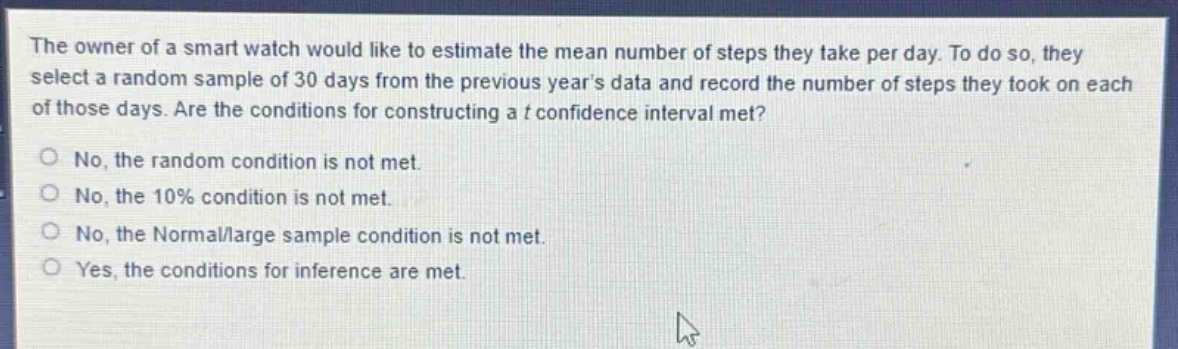
the owner of a smart watch would like to estimate the mean number of steps they take per day. to do so, they select a random sample of 30 days from the previous years data and record the number of steps they took on each of those days. are the conditions for constructing a t confidence interval met?\nno, the random condition is not met.\nno, the 10% condition is not met.\nno, the normal/large sample condition is not met.\nyes, the conditions for inference are met.
Answer
Explanation:
Step1: Check random condition
The owner selects a random sample of 30 days, so the random condition is met.
Step2: Check 10% condition
There are 365 days in a year. Since $30<0.1\times365 = 36.5$, the 10% condition is met.
Step3: Check Normal/Large - sample condition
The sample size $n = 30$. By the Central - Limit Theorem, for a sample size of $n\geq30$, the sampling distribution of the sample mean is approximately normal (even if the population distribution is not normal). So the Normal/Large - sample condition is met.
Answer:
Yes, the conditions for inference are met.