paint color preference\n| |children|adults|total|\n|--|--|--|--|\n|liked new paint color|0.6|x|0.77|\n|dislik…
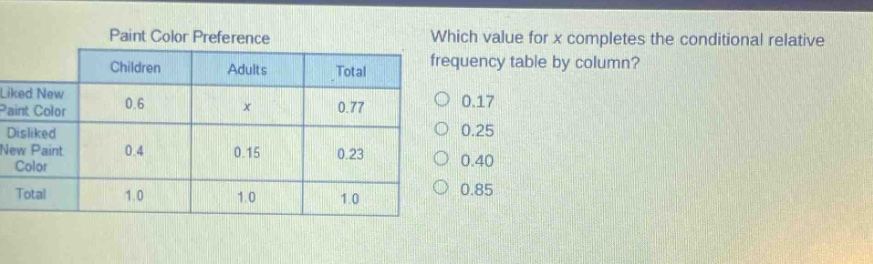
paint color preference\n| |children|adults|total|\n|--|--|--|--|\n|liked new paint color|0.6|x|0.77|\n|disliked new paint color|0.4|0.15|0.23|\n|total|1.0|1.0|1.0|\nwhich value for x completes the conditional relative frequency table by column?\n0.17\n0.25\n0.40\n0.85
Answer
Answer:
0.85
Explanation:
Step1: Recall column - total property
In a conditional relative - frequency table by column, the sum of the conditional relative frequencies in each column is 1.
Step2: Set up the equation
For the "Adults" column, let the unknown value be (x). We know that the sum of the conditional relative frequencies for adults who liked the new paint color ((x)) and those who disliked it (0.15) must equal 1. So, (x + 0.15=1).
Step3: Solve the equation
Subtract 0.15 from both sides of the equation: (x=1 - 0.15). (x = 0.85).