part a what is the maximum number of small boxes that can fit inside the large box? part b the company plans…
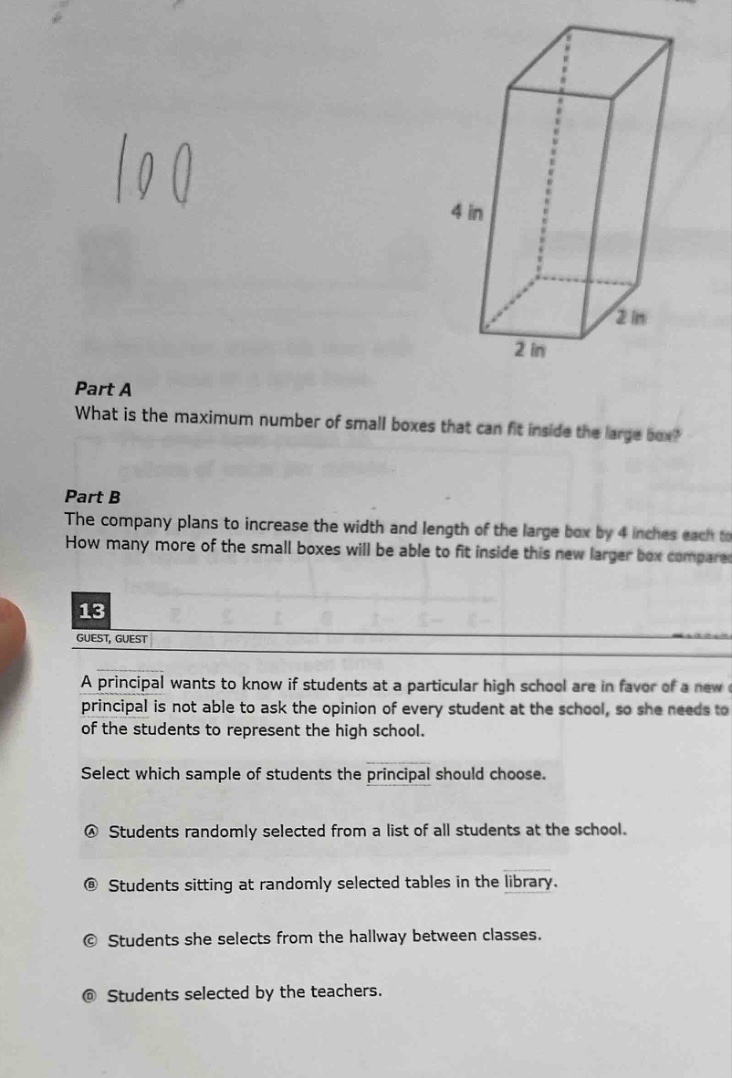
part a what is the maximum number of small boxes that can fit inside the large box? part b the company plans to increase the width and length of the large box by 4 inches each. how many more of the small boxes will be able to fit inside this new larger box compared 13 guest, guest a principal wants to know if students at a particular high school are in favor of a new principal is not able to ask the opinion of every student at the school, so she needs to of the students to represent the high school. select which sample of students the principal should choose. a students randomly selected from a list of all students at the school. b students sitting at randomly selected tables in the library. c students she selects from the hallway between classes. d students selected by the teachers.
Answer
Part A
Explanation:
Step1: Calcular volúmenes
El volumen del cuerpo rectangular (box) se calcula con la fórmula $V = l\times w\times h$. El volumen del gran box es $V_{1}=l_{1}\times w_{1}\times h_{1}=2\times2\times4 = 16$ pulgadas cúbicas. Supongamos que el volumen de los pequeños boxes es de 1 pulgada cúbica (ya que no se especifica su tamaño, pero para calcular la cantidad que caben necesitamos un valor, y si no se da, este es un supuesto razonable).
Step2: Calcular cantidad de boxes
Para encontrar el número máximo de small - boxes que caben en el gran box, dividimos el volumen del gran box entre el volumen del small - box. Sea $n$ el número de small - boxes. Entonces $n=\frac{V_{1}}{V_{small}}$. Si $V_{small} = 1$ pulgada cúbica, entonces $n = 16$.
Answer:
16
Part B
Explanation:
Step1: Calcular nuevos dimensiones
Las nuevas dimensiones del box son $l_{2}=2 + 4=6$ pulgadas, $w_{2}=2 + 4 = 6$ pulgadas y $h_{2}=4$ pulgadas.
Step2: Calcular nuevo volumen
El nuevo volumen $V_{2}=l_{2}\times w_{2}\times h_{2}=6\times6\times4=144$ pulgadas cúbicas.
Step3: Calcular nueva cantidad de boxes
Si $V_{small}=1$ pulgada cúbica, el nuevo número de small - boxes que caben es $n_{2}=\frac{V_{2}}{V_{small}}=144$.
Step4: Calcular diferencia
La diferencia en la cantidad de small - boxes es $n_{2}-n=144 - 16=128$.
Answer:
128
Parte 13
Brief Explanations:
Para tener una muestra representativa de la opinión de los estudiantes de un instituto, se debe elegir una muestra aleatoria de la población total de estudiantes. Elegir estudiantes aleatoriamente de una lista de todos los estudiantes del instituto es el método más adecuado, ya que todos los estudiantes tienen la misma probabilidad de ser seleccionados. Las otras opciones (estudiantes en la biblioteca, en el pasillo o seleccionados por los maestros) pueden ser sesgadas, ya que no representan equitativamente a todos los estudiantes del instituto.
Answer:
A. Students randomly selected from a list of all students at the school.