past studies have indicated that the percentage of smokers is estimated to be about 35%. given the new…
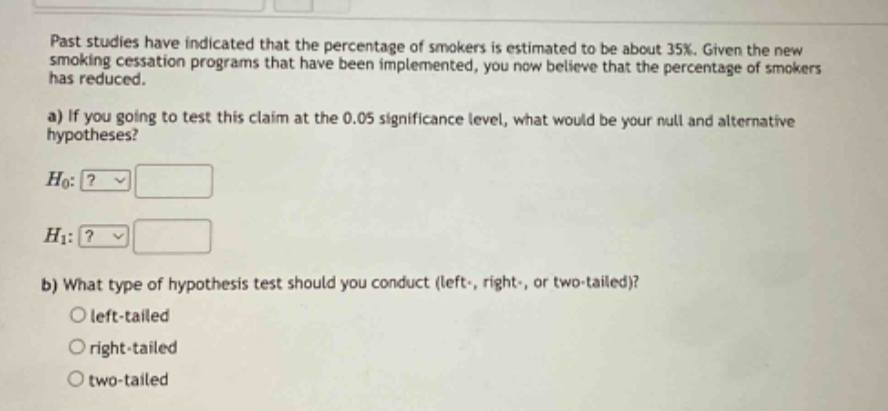
past studies have indicated that the percentage of smokers is estimated to be about 35%. given the new smoking cessation programs that have been implemented, you now believe that the percentage of smokers has reduced. a) if you going to test this claim at the 0.05 significance level, what would be your null and alternative hypotheses? h0:? h1:? b) what type of hypothesis test should you conduct (left-, right-, or two - tailed)? left - tailed right - tailed two - tailed
Answer
Explanation:
Step1: Define null hypothesis
The null hypothesis $H_0$ is a statement of no - effect or no - change. Here, it assumes the proportion of smokers has not changed. So $H_0:p = 0.35$.
Step2: Define alternative hypothesis
The claim is that the percentage of smokers has reduced. So the alternative hypothesis $H_1:p<0.35$.
Step3: Determine test type
Since the alternative hypothesis has a less - than sign ($<$), we conduct a left - tailed test.
Answer:
a) $H_0:p = 0.35$ $H_1:p<0.35$ b) left - tailed