payton collected data to show the relationship between the number of hours he practices and the number of…
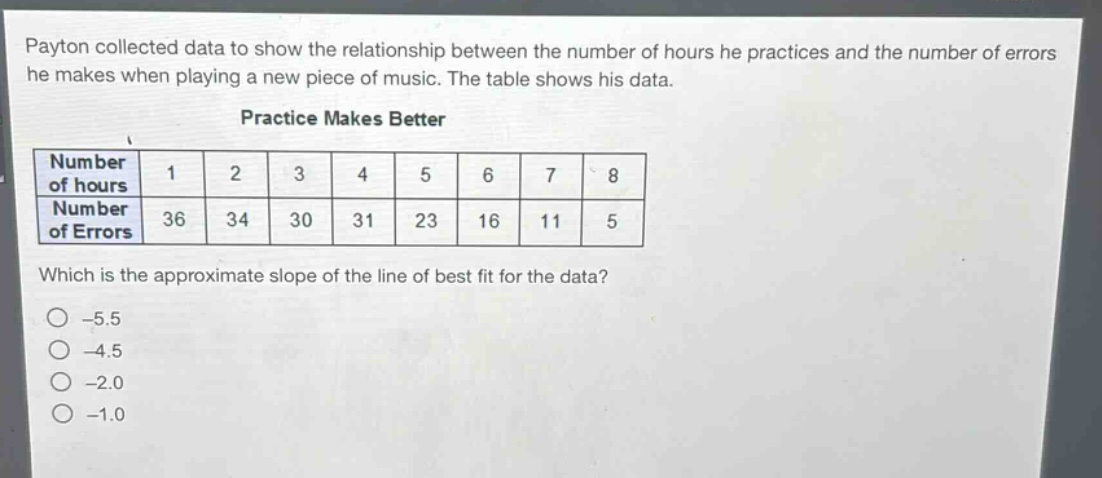
payton collected data to show the relationship between the number of hours he practices and the number of errors he makes when playing a new piece of music. the table shows his data.\npractice makes better\n|number of hours|1|2|3|4|5|6|7|8|\n|number of errors|36|34|30|31|23|16|11|5|\nwhich is the approximate slope of the line of best fit for the data?\n-5.5\n-4.5\n-2.0\n-1.0
Answer
Answer:
-4.5
Explanation:
Step1: Recall slope formula
$m=\frac{\sum_{i = 1}^{n}(x_i-\bar{x})(y_i - \bar{y})}{\sum_{i=1}^{n}(x_i-\bar{x})^2}$ Let $x$ be the number of hours and $y$ be the number of errors. $\bar{x}=\frac{1 + 2+3+4+5+6+7+8}{8}=\frac{36}{8} = 4.5$ $\bar{y}=\frac{36+34+30+31+23+16+11+5}{8}=\frac{186}{8}=23.25$
Step2: Calculate numerator terms
For $(x_1,y_1)=(1,36)$: $(1 - 4.5)(36 - 23.25)=(-3.5)\times12.75=-44.625$ For $(x_2,y_2)=(2,34)$: $(2 - 4.5)(34 - 23.25)=(-2.5)\times10.75=-26.875$ For $(x_3,y_3)=(3,30)$: $(3 - 4.5)(30 - 23.25)=(-1.5)\times6.75=-10.125$ For $(x_4,y_4)=(4,31)$: $(4 - 4.5)(31 - 23.25)=(-0.5)\times7.75=-3.875$ For $(x_5,y_5)=(5,23)$: $(5 - 4.5)(23 - 23.25)=(0.5)\times(-0.25)=-0.125$ For $(x_6,y_6)=(6,16)$: $(6 - 4.5)(16 - 23.25)=(1.5)\times(-7.25)=-10.875$ For $(x_7,y_7)=(7,11)$: $(7 - 4.5)(11 - 23.25)=(2.5)\times(-12.25)=-30.625$ For $(x_8,y_8)=(8,5)$: $(8 - 4.5)(5 - 23.25)=(3.5)\times(-18.25)=-63.875$ Sum of these products $\sum_{i = 1}^{8}(x_i-\bar{x})(y_i - \bar{y})=-181$
Step3: Calculate denominator terms
$(1 - 4.5)^2=(-3.5)^2 = 12.25$ $(2 - 4.5)^2=(-2.5)^2 = 6.25$ $(3 - 4.5)^2=(-1.5)^2 = 2.25$ $(4 - 4.5)^2=(-0.5)^2 = 0.25$ $(5 - 4.5)^2=(0.5)^2 = 0.25$ $(6 - 4.5)^2=(1.5)^2 = 2.25$ $(7 - 4.5)^2=(2.5)^2 = 6.25$ $(8 - 4.5)^2=(3.5)^2 = 12.25$ Sum of these squares $\sum_{i=1}^{8}(x_i-\bar{x})^2 = 40.5$
Step4: Calculate slope
$m=\frac{-181}{40.5}\approx - 4.5$