there are 7 people fishing at lake connor: 5 have fishing licenses, and 2 do not. an inspector chooses two…
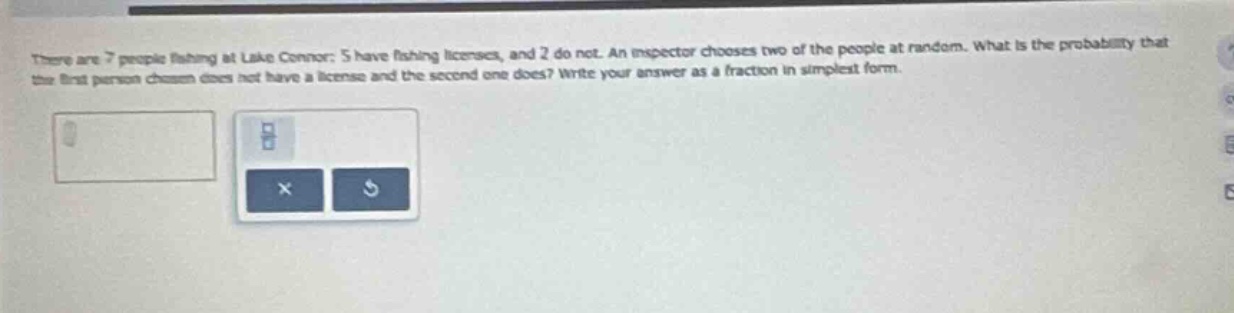
there are 7 people fishing at lake connor: 5 have fishing licenses, and 2 do not. an inspector chooses two of the people at random. what is the probability that the first person chosen does not have a license and the second one does? write your answer as a fraction in simplest form.
Answer
Explanation:
Step1: Calculate probability of first - no license
The probability that the first person chosen does not have a license is the number of people without a license divided by the total number of people. There are 2 people without a license and 7 total people, so the probability $P_1=\frac{2}{7}$.
Step2: Calculate probability of second - has license
After choosing one person without a license, there are 6 people left, and 5 of them have licenses. So the probability that the second person chosen has a license given that the first one did not is $P_2 = \frac{5}{6}$.
Step3: Calculate combined probability
Since these are independent - like sequential events, we multiply the probabilities of each step. The probability that the first person has no license and the second has a license is $P = P_1\times P_2$. $P=\frac{2}{7}\times\frac{5}{6}=\frac{10}{42}=\frac{5}{21}$.
Answer:
$\frac{5}{21}$