people at the state fair were surveyed about which type of lemonade they preferred. the results are shown…
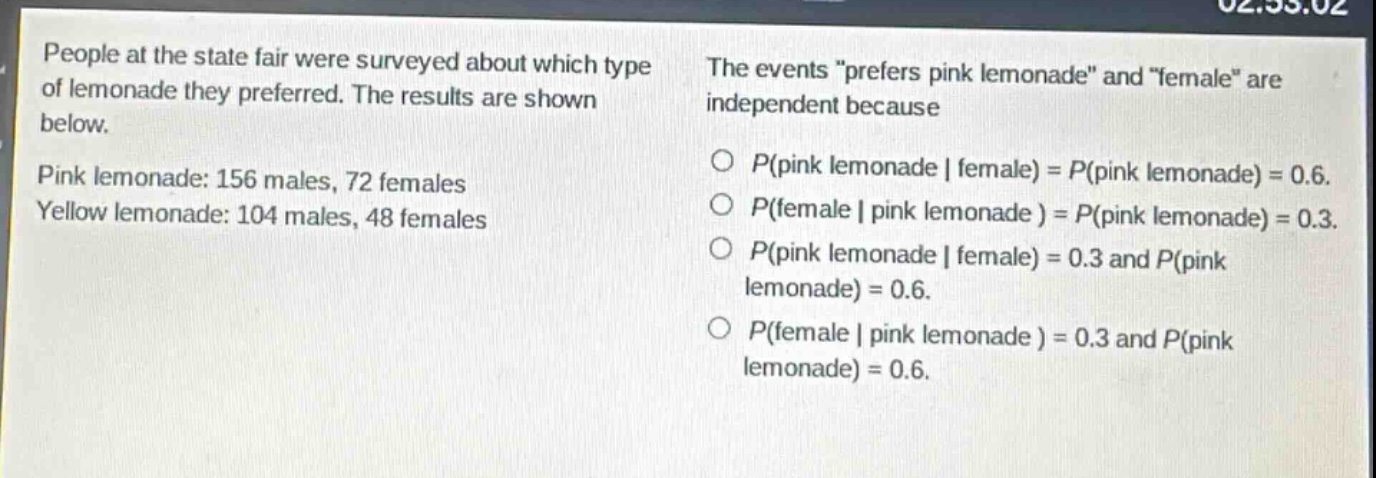
people at the state fair were surveyed about which type of lemonade they preferred. the results are shown below. pink lemonade: 156 males, 72 females yellow lemonade: 104 males, 48 females the events “prefers pink lemonade” and “female” are independent because o p(pink lemonade | female) = p(pink lemonade) = 0.6. o p(female | pink lemonade ) = p(pink lemonade) = 0.3. o p(pink lemonade | female) = 0.3 and p(pink lemonade) = 0.6. o p(female | pink lemonade ) = 0.3 and p(pink lemonade) = 0.6.
Answer
Answer:
A. $P(\text{pink lemonade}|\text{female}) = P(\text{pink lemonade})=0.6$
Explanation:
Step1: Calculate total number of people
Total number of people = $156 + 72+104 + 48=380$.
Step2: Calculate $P(\text{pink lemonade})$
Number of people who prefer pink lemonade = $156 + 72 = 228$. So $P(\text{pink lemonade})=\frac{228}{380}=0.6$.
Step3: Calculate number of females
Number of females = $72 + 48=120$.
Step4: Calculate $P(\text{pink lemonade}|\text{female})$
Number of females who prefer pink lemonade = $72$. So $P(\text{pink lemonade}|\text{female})=\frac{72}{120}=0.6$. Since for two - events $A$ and $B$, $A$ and $B$ are independent if $P(A|B)=P(A)$. Here $A$ is the event of preferring pink lemonade and $B$ is the event of being female, and $P(\text{pink lemonade}|\text{female}) = P(\text{pink lemonade}) = 0.6$, the events are independent.