every person has blood type o, a, b, or ab. a random group of people are blood - typed, and the results are…
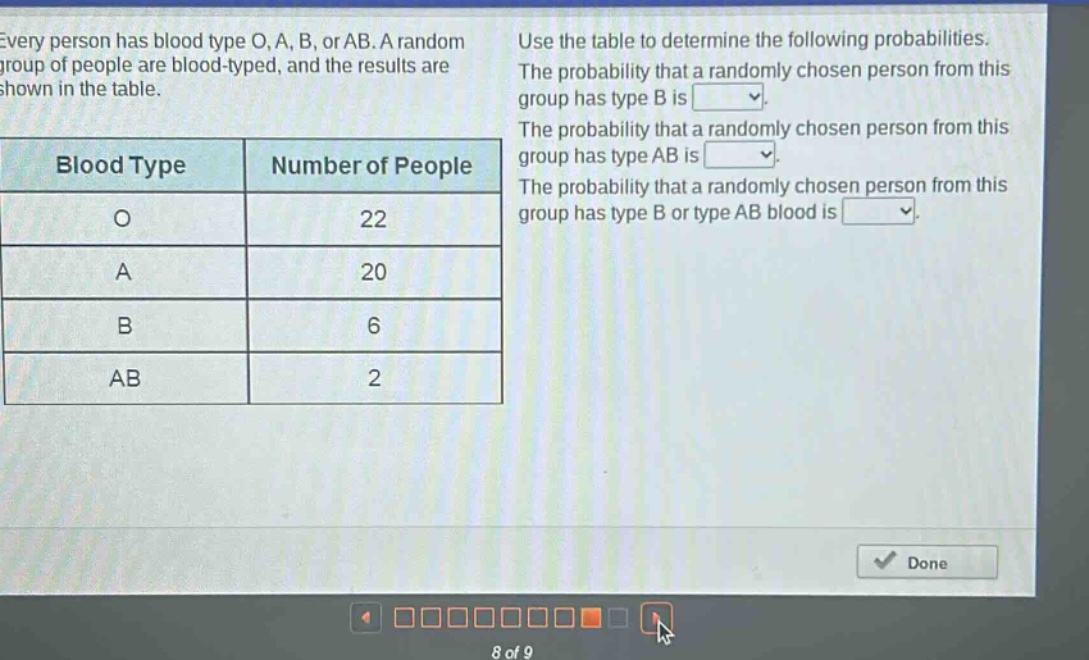
every person has blood type o, a, b, or ab. a random group of people are blood - typed, and the results are shown in the table. use the table to determine the following probabilities. the probability that a randomly chosen person from this group has type b is. the probability that a randomly chosen person from this group has type ab is. the probability that a randomly chosen person from this group has type b or type ab blood is. blood type|number of people o|22 a|20 b|6 ab|2
Answer
Explanation:
Step1: Calculate total number of people
$22 + 20+6 + 2=50$
Step2: Calculate probability of type B
The probability formula is $P=\frac{\text{Number of favorable outcomes}}{\text{Total number of outcomes}}$. For type B, $P(B)=\frac{6}{50}=\frac{3}{25}$
Step3: Calculate probability of type AB
$P(AB)=\frac{2}{50}=\frac{1}{25}$
Step4: Calculate probability of type B or type AB
Since B and AB are mutually - exclusive events, $P(B\cup AB)=P(B)+P(AB)$. So $P(B\cup AB)=\frac{6 + 2}{50}=\frac{8}{50}=\frac{4}{25}$
Answer:
The probability that a randomly chosen person from this group has type B is $\frac{3}{25}$. The probability that a randomly chosen person from this group has type AB is $\frac{1}{25}$. The probability that a randomly chosen person from this group has type B or type AB blood is $\frac{4}{25}$.