can a person train to become better at holding their breath? an experiment was designed to find out. twelve…
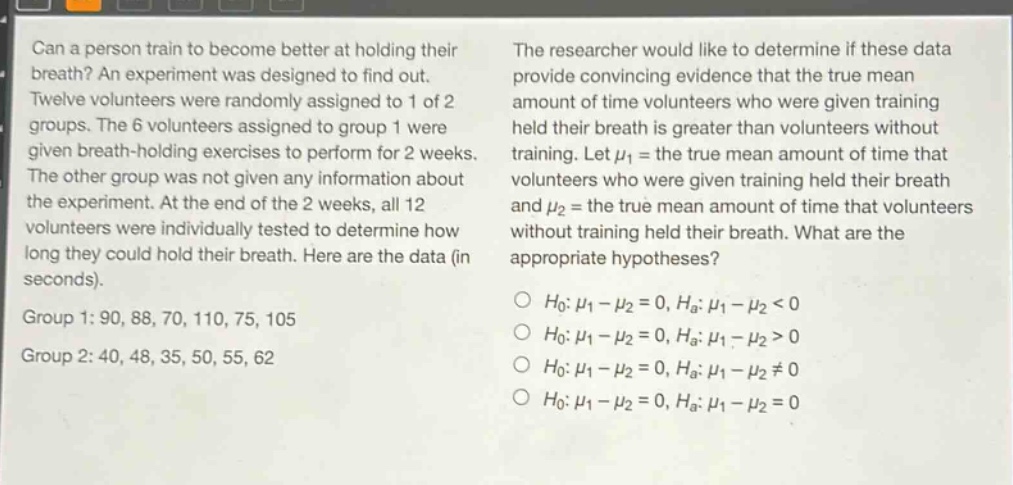
can a person train to become better at holding their breath? an experiment was designed to find out. twelve volunteers were randomly assigned to 1 of 2 groups. the 6 volunteers assigned to group 1 were given breath - holding exercises to perform for 2 weeks. the other group was not given any information about the experiment. at the end of the 2 weeks, all 12 volunteers were individually tested to determine how long they could hold their breath. here are the data (in seconds). group 1: 90, 88, 70, 110, 75, 105 group 2: 40, 48, 35, 50, 55, 62 the researcher would like to determine if these data provide convincing evidence that the true mean amount of time volunteers who were given training held their breath is greater than volunteers without training. let $mu_1$ = the true mean amount of time that volunteers who were given training held their breath and $mu_2$ = the true mean amount of time that volunteers without training held their breath. what are the appropriate hypotheses? o $h_0:mu_1-mu_2 = 0, h_a:mu_1-mu_2<0$ o $h_0:mu_1-mu_2 = 0, h_a:mu_1-mu_2>0$ o $h_0:mu_1-mu_2 = 0, h_a:mu_1-mu_2\neq0$ o $h_0:mu_1-mu_2 = 0, h_a:mu_1-mu_2 = 0$
Answer
Explanation:
Step1: Identify the null and alternative hypotheses concept
The null hypothesis $H_0$ is usually a statement of no - effect or no difference. The alternative hypothesis $H_a$ is what we are trying to find evidence for. Here, we want to test if the true mean amount of time volunteers who were given training held their breath is greater than volunteers without training. The null hypothesis is that there is no difference between the two means, i.e., $H_0:\mu_1-\mu_2 = 0$. The alternative hypothesis is that the mean of group 1 (trained) is greater than the mean of group 2 (untrained), so $H_a:\mu_1-\mu_2>0$.
Answer:
$H_0:\mu_1 - \mu_2=0, H_a:\mu_1 - \mu_2>0$