at a pet store, the lizards in aquarium a have a mean length of 13 cm and vary from 9 cm to 15 cm. in…
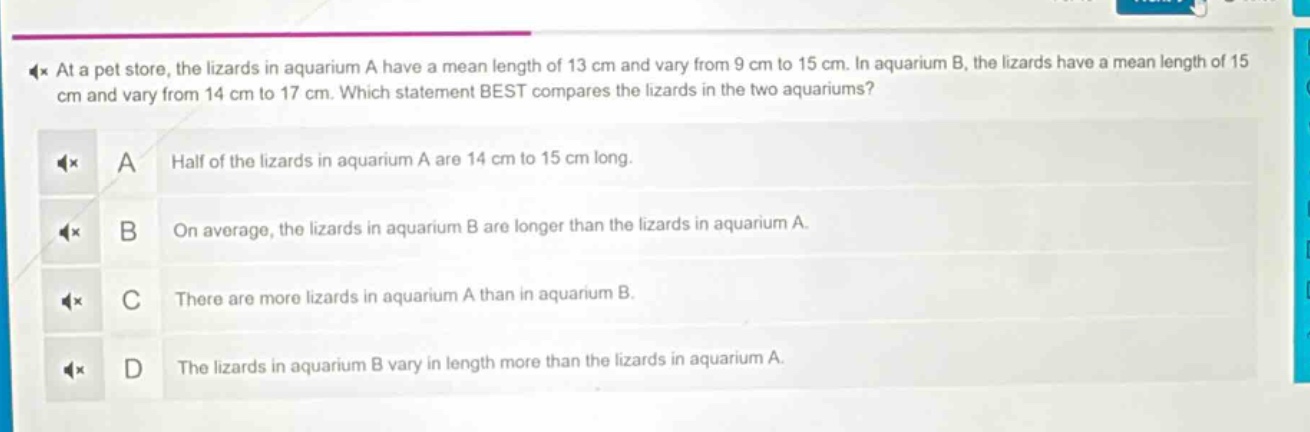
at a pet store, the lizards in aquarium a have a mean length of 13 cm and vary from 9 cm to 15 cm. in aquarium b, the lizards have a mean length of 15 cm and vary from 14 cm to 17 cm. which statement best compares the lizards in the two aquariums? a half of the lizards in aquarium a are 14 cm to 15 cm long. b on average, the lizards in aquarium b are longer than the lizards in aquarium a. c there are more lizards in aquarium a than in aquarium b. d the lizards in aquarium b vary in length more than the lizards in aquarium a.
Answer
Explanation:
Step1: Analyze option A
Just knowing the range and mean of aquarium A's lizards doesn't mean half are (14 - 15) cm. No data supports this.
Step2: Analyze option B
Mean of aquarium A is (13) cm, mean of aquarium B is (15) cm. Since (15>13), on average, lizards in B are longer.
Step3: Analyze option C
There is no information about the number of lizards in each aquarium.
Step4: Analyze option D
Range of aquarium A: (15 - 9=6) cm. Range of aquarium B: (17 - 14 = 3) cm. So lizards in A vary more.
Answer:
B. On average, the lizards in aquarium B are longer than the lizards in aquarium A.