a pet store surveyed 150 residents in hillcrest to find out whether they have pets. the pet store also asked…
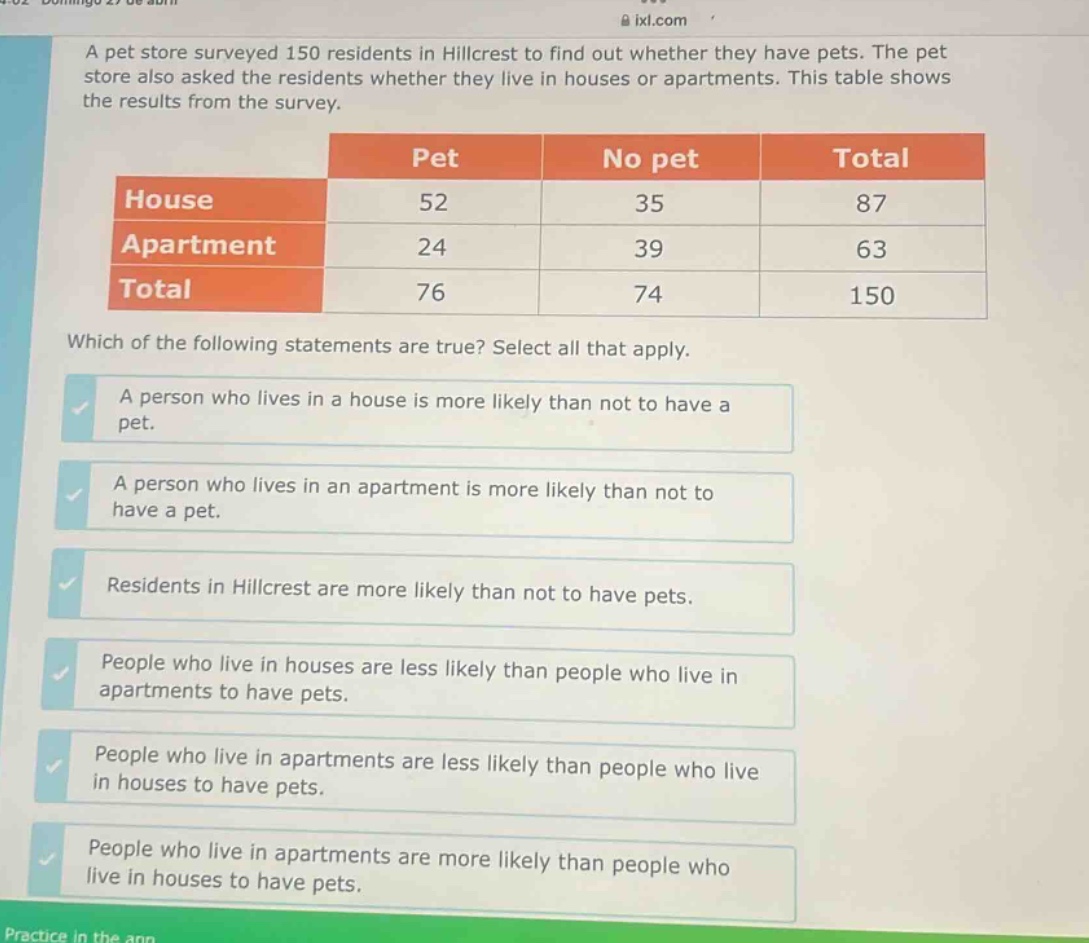
a pet store surveyed 150 residents in hillcrest to find out whether they have pets. the pet store also asked the residents whether they live in houses or apartments. this table shows the results from the survey.\n| |pet|no pet|total|\n|--|--|--|--|\n|house|52|35|87|\n|apartment|24|39|63|\n|total|76|74|150|\nwhich of the following statements are true? select all that apply.\na person who lives in a house is more likely than not to have a pet.\na person who lives in an apartment is more likely than not to have a pet.\nresidents in hillcrest are more likely than not to have pets.\npeople who live in houses are less likely than people who live in apartments to have pets.\npeople who live in apartments are less likely than people who live in houses to have pets.\npeople who live in apartments are more likely than people who live in houses to have pets.
Answer
Explanation:
Step1: Calcular probabilidad de tener mascota para residentes de casas
La probabilidad $P(\text{mascota}|\text{casa})$ se calcula como $\frac{\text{residentes de casas con mascota}}{\text{total residentes de casas}}=\frac{52}{87}\approx 0.598$. Como $0.598 > 0.5$, es más probable tener mascota si vives en una casa.
Step2: Calcular probabilidad de tener mascota para residentes de apartamentos
La probabilidad $P(\text{mascota}|\text{apartamento})$ se calcula como $\frac{\text{residentes de apartamentos con mascota}}{\text{total residentes de apartamentos}}=\frac{24}{63}\approx 0.381$. Como $0.381<0.5$, es menos probable tener mascota si vives en un apartamento.
Step3: Calcular probabilidad general de tener mascota
La probabilidad $P(\text{mascota})$ se calcula como $\frac{\text{total residentes con mascota}}{\text{total residentes}}=\frac{76}{150}\approx 0.507$. Como $0.507 > 0.5$, los residentes de Hillcrest son más propensos a tener mascotas.
Step4: Comparar probabilidades entre casas y apartamentos
Como $\frac{52}{87}\approx 0.598$ y $\frac{24}{63}\approx 0.381$, las personas que viven en casas son más propensas a tener mascotas que las que viven en apartamentos.
Answer:
A. A person who lives in a house is more likely than not to have a pet. E. People who live in apartments are less likely than people who live in houses to have pets. C. Residents in Hillcrest are more likely than not to have pets.