peter guesses on all 10 questions of a multiple - choice quiz. each question has 4 answer choices, and peter…
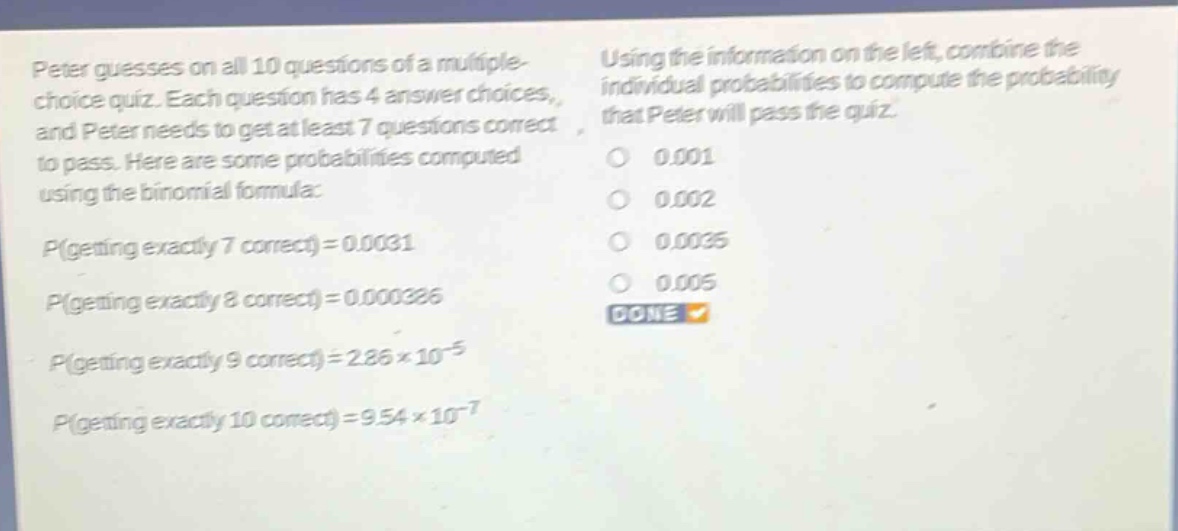
peter guesses on all 10 questions of a multiple - choice quiz. each question has 4 answer choices, and peter needs to get at least 7 questions correct to pass. here are some probabilities computed using the binomial formula: p(getting exactly 7 correct)=0.0031 p(getting exactly 8 correct)=0.000386 p(getting exactly 9 correct)=2.86×10⁻⁵ p(getting exactly 10 correct)=9.54×10⁻⁷ using the information on the left, combine the individual probabilities to compute the probability that peter will pass the quiz. 0.001 0.002 0.0035 0.005 done
Answer
Explanation:
Step1: Identify passing - condition
Peter passes if he gets 7, 8, 9, or 10 questions correct.
Step2: Use probability addition rule
The probability of passing is (P(X\geq7)=P(X = 7)+P(X = 8)+P(X = 9)+P(X = 10)).
Step3: Substitute given probabilities
(P(X = 7)=0.0031), (P(X = 8)=0.000386), (P(X = 9)=2.86\times10^{-5}=0.0000286), (P(X = 10)=9.54\times10^{-7}=0.000000954).
Step4: Calculate sum
(P(X\geq7)=0.0031 + 0.000386+0.0000286 + 0.000000954=0.003515554\approx0.0035).
Answer:
0.0035