plans after high school\n| | college | not college | total |\n|--|--|--|--|\n| travel | 43 | 10 | 53 |\n|…
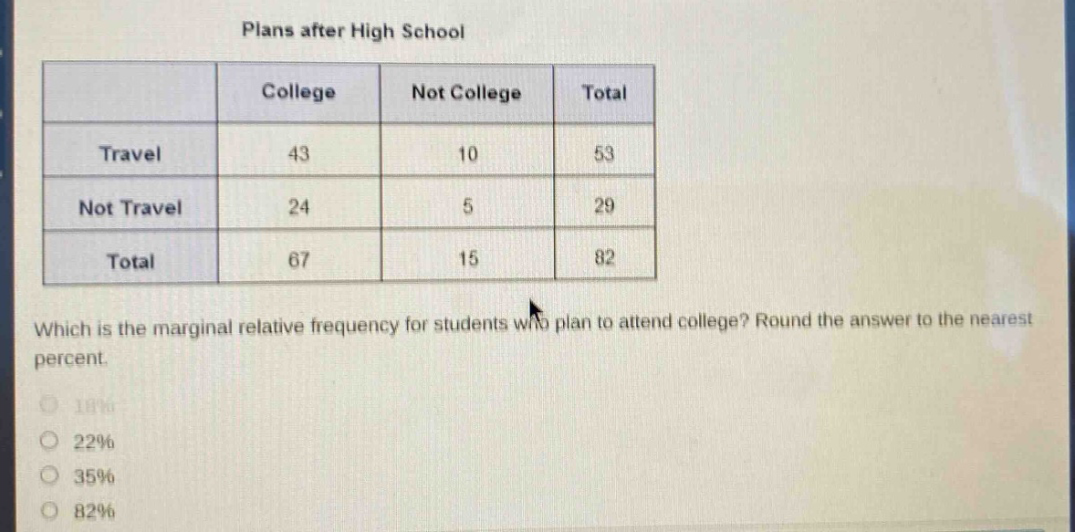
plans after high school\n| | college | not college | total |\n|--|--|--|--|\n| travel | 43 | 10 | 53 |\n| not travel | 24 | 5 | 29 |\n| total | 67 | 15 | 82 |\nwhich is the marginal relative frequency for students who plan to attend college? round the answer to the nearest percent.\n18%\n22%\n35%\n82%
Answer
Explanation:
Step1: Recall marginal relative frequency formula
Marginal relative frequency = $\frac{\text{Row/Column Total}}{\text{Grand Total}}$
Step2: Identify relevant values
The number of students who plan to attend college (column - total) is 67, and the grand - total of all students is 82.
Step3: Calculate marginal relative frequency
Marginal relative frequency = $\frac{67}{82}\approx0.817$
Step4: Convert to percentage
$0.817\times100 = 81.7%$. Rounding to the nearest percent gives 82%.
Answer:
82%