7. (3 points) the general social survey asked 1000 people how many hours per day they were able to relax…
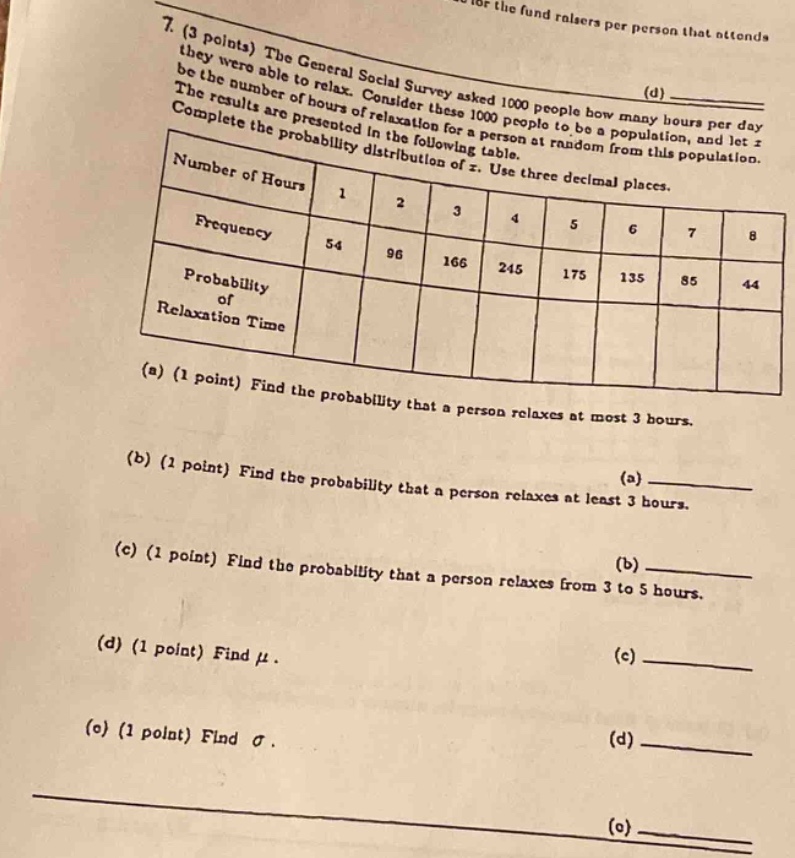
7. (3 points) the general social survey asked 1000 people how many hours per day they were able to relax. consider these 1000 people to be a population, and let x be the number of hours of relaxation for a person at random from this population. the results are presented in the following table. complete the probability distribution of x. use three decimal places. number of hours 1 2 3 4 5 6 7 8 frequency 54 96 166 245 175 135 85 44 probability of relaxation time (a) (1 point) find the probability that a person relaxes at most 3 hours. (b) (1 point) find the probability that a person relaxes at least 3 hours. (c) (1 point) find the probability that a person relaxes from 3 to 5 hours. (d) (1 point) find μ. (e) (1 point) find σ.
Answer
Explanation:
Step1: Calculate total frequency
The total number of people surveyed is $n = 54+96 + 166+245+175+135+85+44=1000$.
Step2: Calculate probabilities for each number of hours
The probability $P(x)$ for a given number of hours $x$ is $P(x)=\frac{\text{Frequency of }x}{n}$. For $x = 1$, $P(1)=\frac{54}{1000}=0.054$. For $x = 2$, $P(2)=\frac{96}{1000}=0.096$. For $x = 3$, $P(3)=\frac{166}{1000}=0.166$. For $x = 4$, $P(4)=\frac{245}{1000}=0.245$. For $x = 5$, $P(5)=\frac{175}{1000}=0.175$. For $x = 6$, $P(6)=\frac{135}{1000}=0.135$. For $x = 7$, $P(7)=\frac{85}{1000}=0.085$. For $x = 8$, $P(8)=\frac{44}{1000}=0.044$.
Step3: Answer part (a)
The probability that a person relaxes at most 3 hours is $P(X\leq3)=P(1)+P(2)+P(3)=0.054 + 0.096+0.166=0.316$.
Step4: Answer part (b)
The probability that a person relaxes at least 3 hours is $P(X\geq3)=1 - P(X < 3)=1-(P(1)+P(2))=1-(0.054 + 0.096)=0.85$.
Step5: Answer part (c)
The probability that a person relaxes from 3 to 5 hours is $P(3\leq X\leq5)=P(3)+P(4)+P(5)=0.166+0.245 + 0.175=0.586$.
Step6: Answer part (d)
The mean $\mu=\sum_{x = 1}^{8}x\cdot P(x)$ [ \begin{align*} \mu&=1\times0.054+2\times0.096 + 3\times0.166+4\times0.245+5\times0.175+6\times0.135+7\times0.085+8\times0.044\ &=0.054 + 0.192+0.498+0.98+0.875+0.81+0.595+0.352\ &=4.356 \end{align*} ]
Step7: Answer part (e)
The variance $\sigma^{2}=\sum_{x = 1}^{8}(x-\mu)^{2}\cdot P(x)$ [ \begin{align*} \sigma^{2}&=(1 - 4.356)^{2}\times0.054+(2 - 4.356)^{2}\times0.096+(3 - 4.356)^{2}\times0.166+(4 - 4.356)^{2}\times0.245+(5 - 4.356)^{2}\times0.175+(6 - 4.356)^{2}\times0.135+(7 - 4.356)^{2}\times0.085+(8 - 4.356)^{2}\times0.044\ &=(- 3.356)^{2}\times0.054+(-2.356)^{2}\times0.096+(-1.356)^{2}\times0.166+(-0.356)^{2}\times0.245+(0.644)^{2}\times0.175+(1.644)^{2}\times0.135+(2.644)^{2}\times0.085+(3.644)^{2}\times0.044\ &=11.2628\times0.054 + 5.5497\times0.096+1.8397\times0.166 + 0.1267\times0.245+0.4147\times0.175+2.7027\times0.135+6.9807\times0.085+13.2807\times0.044\ &=0.6082+0.5328+0.3054+0.0309+0.0726+0.3649+0.5934+0.5843\ &=3.0925 \end{align*} ] The standard - deviation $\sigma=\sqrt{\sigma^{2}}=\sqrt{3.0925}\approx1.759$.
Answer:
(a) $0.316$ (b) $0.850$ (c) $0.586$ (d) $4.356$ (e) $1.759$