a pop quiz has 2 true/false questions. paris used a 10 - trial coin flip to simulate the results of guessing…
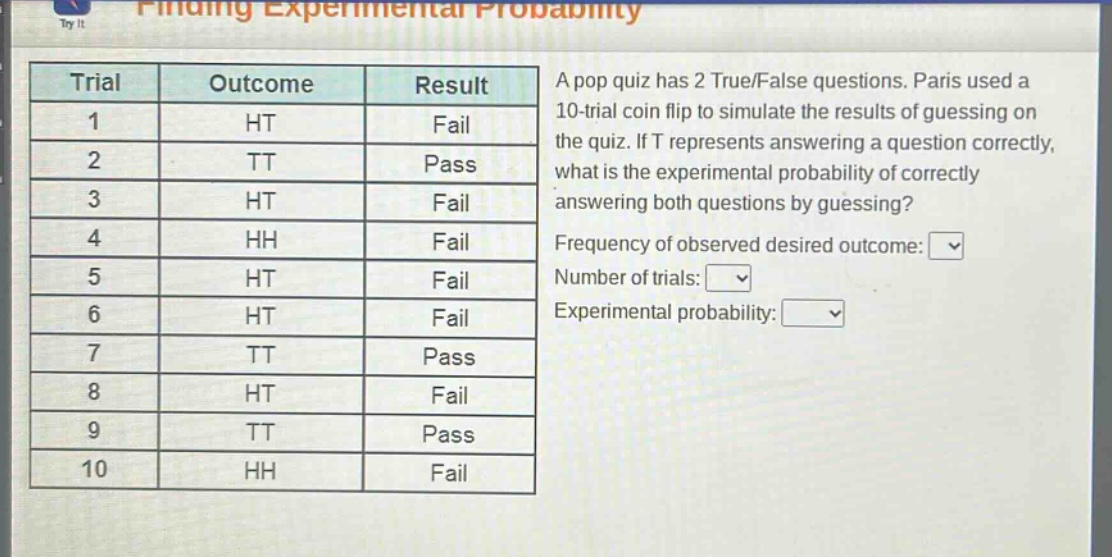
a pop quiz has 2 true/false questions. paris used a 10 - trial coin flip to simulate the results of guessing on the quiz. if t represents answering a question correctly, what is the experimental probability of correctly answering both questions by guessing? frequency of observed desired outcome: number of trials: experimental probability:
Answer
Explanation:
Step1: Identify desired outcome
The desired outcome is answering both questions correctly, which is represented by TT.
Step2: Count frequency of desired outcome
Count the number of times TT appears in the trials. TT appears 3 times. So the frequency of observed desired outcome is 3.
Step3: Determine number of trials
The total number of coin - flip trials is 10.
Step4: Calculate experimental probability
The formula for experimental probability $P$ is $P=\frac{\text{Frequency of desired outcome}}{\text{Number of trials}}$. So $P = \frac{3}{10}=0.3$.
Answer:
Frequency of observed desired outcome: 3 Number of trials: 10 Experimental probability: 0.3