a popular theory is that presidential candidates have an advantage if they are taller than their main…
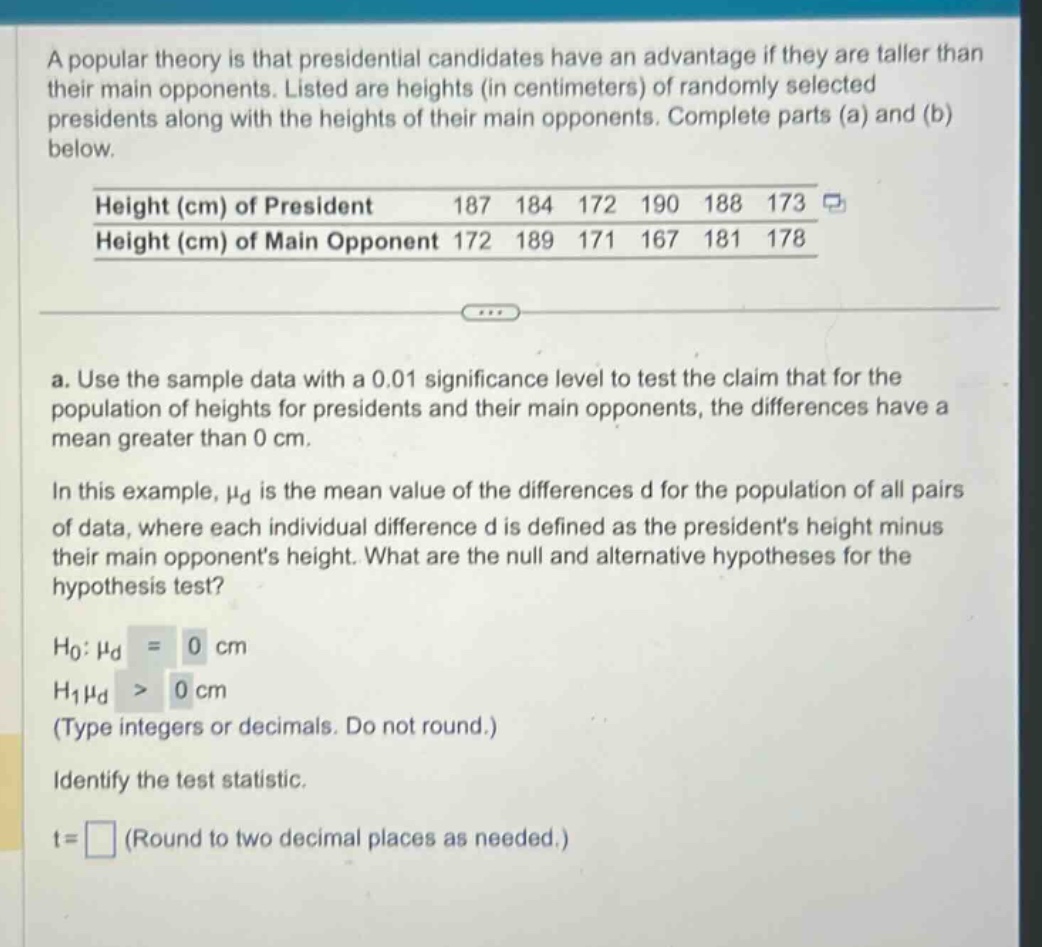
a popular theory is that presidential candidates have an advantage if they are taller than their main opponents. listed are heights (in centimeters) of randomly selected presidents along with the heights of their main opponents. complete parts (a) and (b) below. height (cm) of president 187 184 172 190 188 173 height (cm) of main opponent 172 189 171 167 181 178 a. use the sample data with a 0.01 significance level to test the claim that for the population of heights for presidents and their main opponents, the differences have a mean greater than 0 cm. in this example, μd is the mean value of the differences d for the population of all pairs of data, where each individual difference d is defined as the presidents height minus their main opponents height. what are the null and alternative hypotheses for the hypothesis test? h0: μd = 0 cm h1: μd > 0 cm (type integers or decimals. do not round.) identify the test statistic. t = (round to two decimal places as needed.)
Answer
Answer:
1.15
Explanation:
Step1: Calculate the differences
Let (d) be the president's height - opponent's height. (d_1=187 - 172=15), (d_2=184 - 189=- 5), (d_3=172 - 171 = 1), (d_4=190 - 167=23), (d_5=188 - 181 = 7), (d_6=173 - 178=-5)
Step2: Calculate the mean of differences (\bar{d})
(\bar{d}=\frac{15+( - 5)+1 + 23+7+( - 5)}{6}=\frac{36}{6}=6)
Step3: Calculate the standard - deviation of differences (s_d)
First, find the squared differences from the mean: ((15 - 6)^2=81), ((-5 - 6)^2 = 121), ((1 - 6)^2=25), ((23 - 6)^2 = 289), ((7 - 6)^2=1), ((-5 - 6)^2 = 121) The sum of squared differences (\sum(d_i-\bar{d})^2=81 + 121+25+289+1+121 = 638) (s_d=\sqrt{\frac{\sum(d_i-\bar{d})^2}{n - 1}}=\sqrt{\frac{638}{6 - 1}}=\sqrt{\frac{638}{5}}\approx11.3)
Step4: Calculate the test - statistic (t)
The formula for the test - statistic in a paired - samples (t) - test is (t=\frac{\bar{d}-\mu_d}{s_d/\sqrt{n}}) We have (\bar{d} = 6), (\mu_d = 0), (s_d\approx11.3), (n = 6) (t=\frac{6-0}{11.3/\sqrt{6}}\approx\frac{6}{4.69}\approx1.15)