the populations and land areas of four cities in texas are shown.\n| |population|area (km²)|…
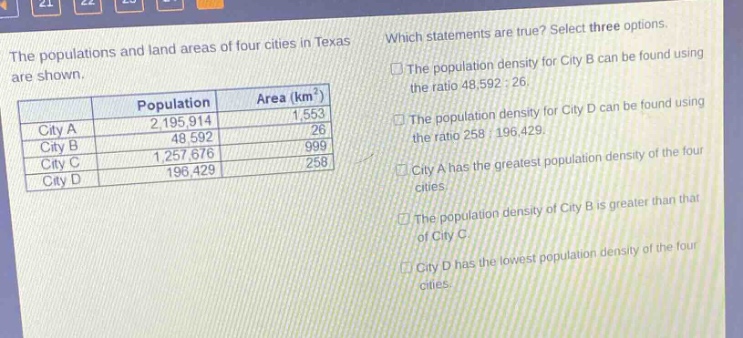
the populations and land areas of four cities in texas are shown.\n| |population|area (km²)| \n|----|----|----| \n|city a|2,195,914|1,553| \n|city b|48,592|26| \n|city c|1,257,676|999| \n|city d|196,429|258| \nwhich statements are true? select three options.\n□ the population density for city b can be found using the ratio 48,592 : 26.\n□ the population density for city d can be found using the ratio 258 : 196,429.\n□ city a has the greatest population density of the four cities.\n□ the population density of city b is greater than that of city c.\n□ city d has the lowest population density of the four cities.
Answer
Explanation:
Step1: Recall population - density formula
Population density = $\frac{\text{Population}}{\text{Area}}$
Step2: Calculate population density of City A
Population density of City A = $\frac{2195914}{1553}\approx1414$ people per $km^{2}$
Step3: Calculate population density of City B
Population density of City B = $\frac{48592}{26}\approx1869$ people per $km^{2}$
Step4: Calculate population density of City C
Population density of City C = $\frac{1257676}{999}\approx1259$ people per $km^{2}$
Step5: Calculate population density of City D
Population density of City D = $\frac{196429}{258}\approx761$ people per $km^{2}$
Step6: Analyze each statement
- For the statement "The population density for City B can be found using the ratio 48,592:26": True, as per the population - density formula.
- For the statement "The population density for City D can be found using the ratio 258:196,429": False, it should be $\frac{196429}{258}$.
- For the statement "City A has the greatest population density of the four cities": False, City B has a greater population density.
- For the statement "The population density of City B is greater than that of City C": True, since $1869>1259$.
- For the statement "City D has the lowest population density of the four cities": True, as $761$ is the lowest among the calculated densities.
Answer:
The population density for City B can be found using the ratio 48,592:26; The population density of City B is greater than that of City C; City D has the lowest population density of the four cities.