the president of a school club would like to purchase t - shirts for members of the club and asks members…
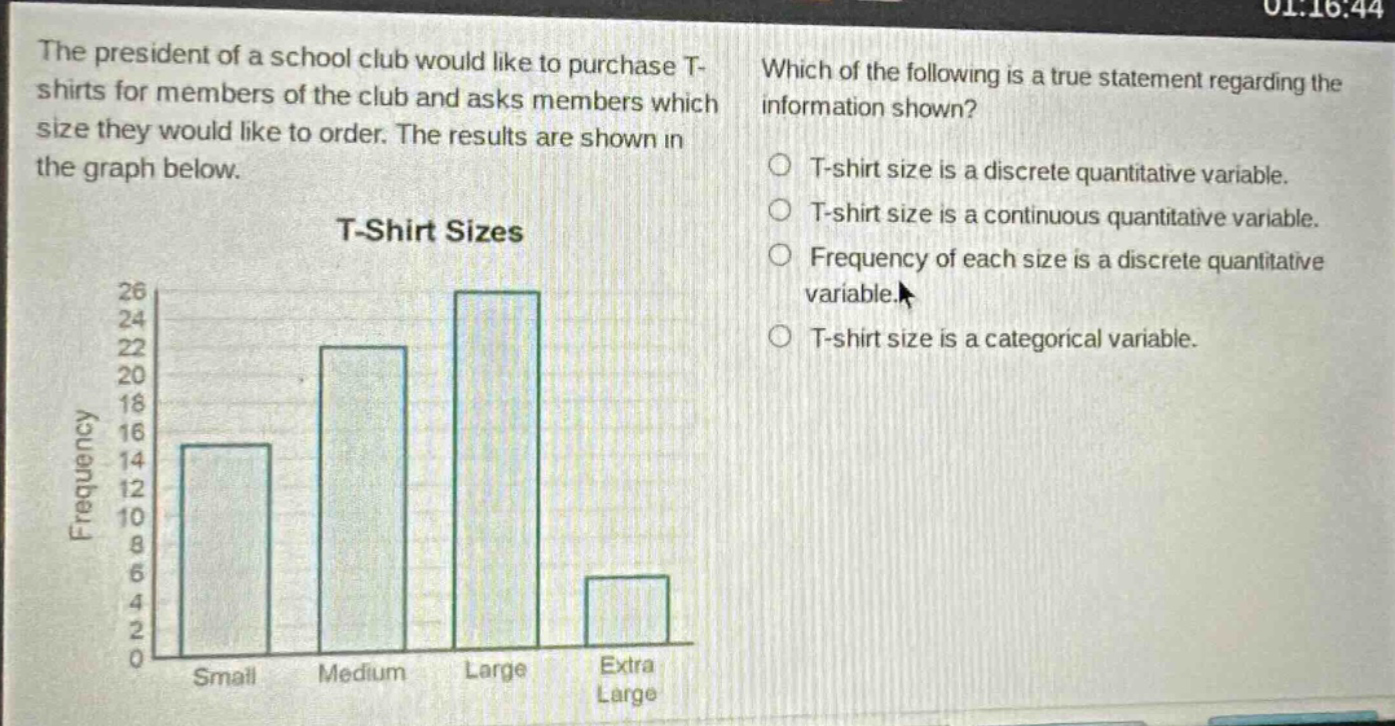
the president of a school club would like to purchase t - shirts for members of the club and asks members which size they would like to order. the results are shown in the graph below. t - shirt sizes which of the following is a true statement regarding the information shown? t - shirt size is a discrete quantitative variable. t - shirt size is a continuous quantitative variable. frequency of each size is a discrete quantitative variable. t - shirt size is a categorical variable.
Answer
Answer:
T-shirt size is a categorical variable.
Explanation:
Step1: Define variable types
Categorical variables represent types or groups. Quantitative variables are numerical. Discrete quantitative has distinct values, continuous can take any value in an interval.
Step2: Analyze T - shirt size
T - shirt sizes (Small, Medium, Large, Extra Large) are categories, not numerical values that can be measured or counted in a quantitative sense. So, T - shirt size is a categorical variable.