in the previous activity, you established that asteroids likely hit earth with the same frequency and at the…
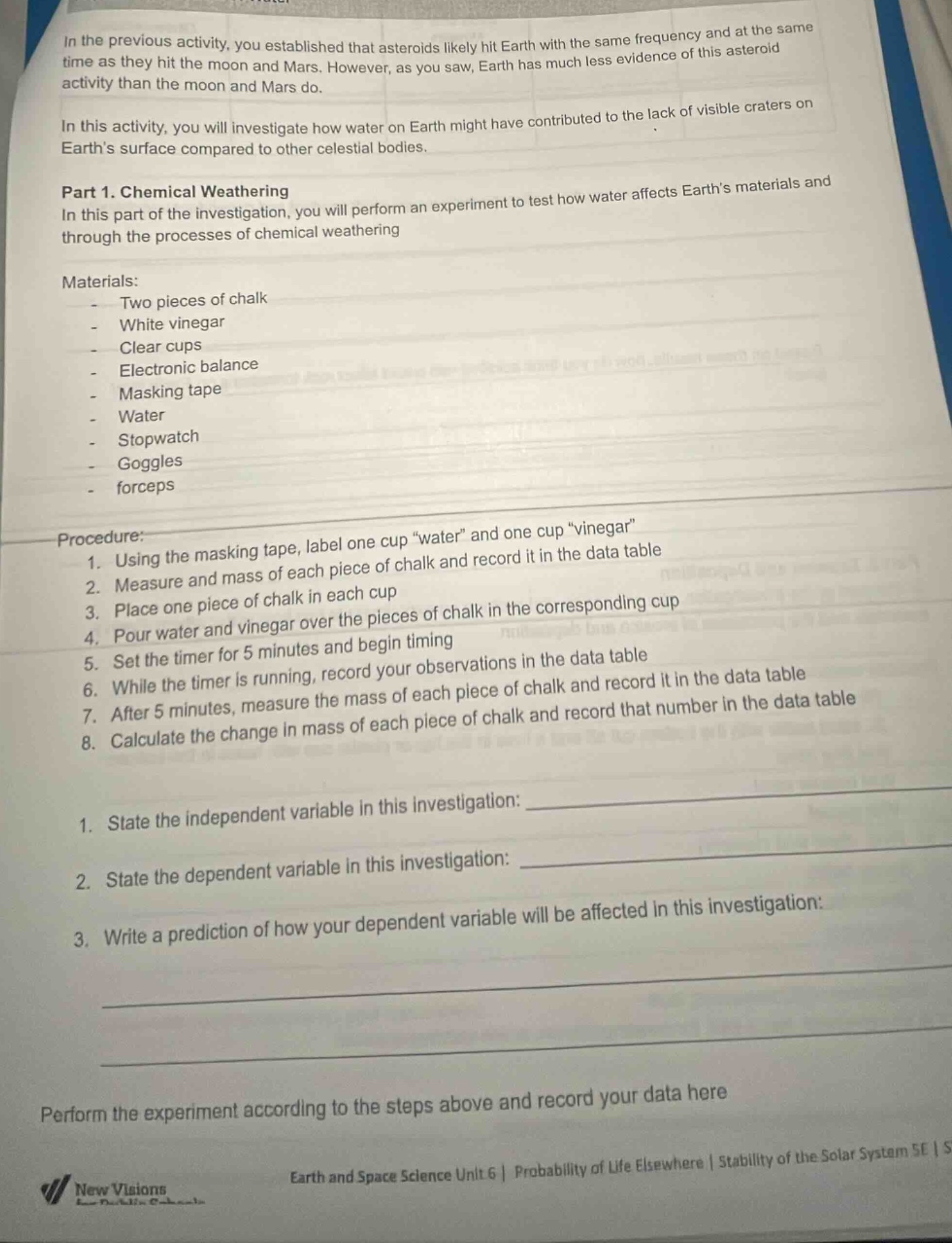
in the previous activity, you established that asteroids likely hit earth with the same frequency and at the same time as they hit the moon and mars. however, as you saw, earth has much less evidence of this asteroid activity than the moon and mars do.\nin this activity, you will investigate how water on earth might have contributed to the lack of visible craters on earth’s surface compared to other celestial bodies.\npart 1. chemical weathering\nin this part of the investigation, you will perform an experiment to test how water affects earth’s materials and through the processes of chemical weathering\nmaterials:\n- two pieces of chalk\n- white vinegar\n- clear cups\n- electronic balance\n- masking tape\n- water\n- stopwatch\n- goggles\n- forceps\nprocedure:\n1. using the masking tape, label one cup “water” and one cup “vinegar”\n2. measure and mass of each piece of chalk and record it in the data table\n3. place one piece of chalk in each cup\n4. pour water and vinegar over the pieces of chalk in the corresponding cup\n5. set the timer for 5 minutes and begin timing\n6. while the timer is running, record your observations in the data table\n7. after 5 minutes, measure the mass of each piece of chalk and record it in the data table\n8. calculate the change in mass of each piece of chalk and record that number in the data table\n1. state the independent variable in this investigation: \n2. state the dependent variable in this investigation: \n3. write a prediction of how your dependent variable will be affected in this investigation:\n\nperform the experiment according to the steps above and record your data here\nearth and space science unit 6 | probability of life elsewhere | stability of the solar system se | s\nnew visions
Answer
Answer:
- The independent variable is the liquid (water or vinegar).
- The dependent variable is the change in mass of the chalk.
- Prediction: The chalk in vinegar will have a greater decrease in mass than the chalk in water because vinegar is an acid and can chemically react with the chalk (calcium carbonate) more vigorously than water, causing more of the chalk to dissolve and thus a larger change in mass.
Explanation:
Step1: Identify independent variable
The variable being changed is the liquid type.
Step2: Identify dependent variable
The variable being measured is the mass - change of chalk.
Step3: Make prediction
Based on chemical - reactivity knowledge. Vinegar (acetic acid) reacts with calcium carbonate in chalk.