from previous experience, the owner of an apple orchard knows that the mean weight of gala apples is 140…
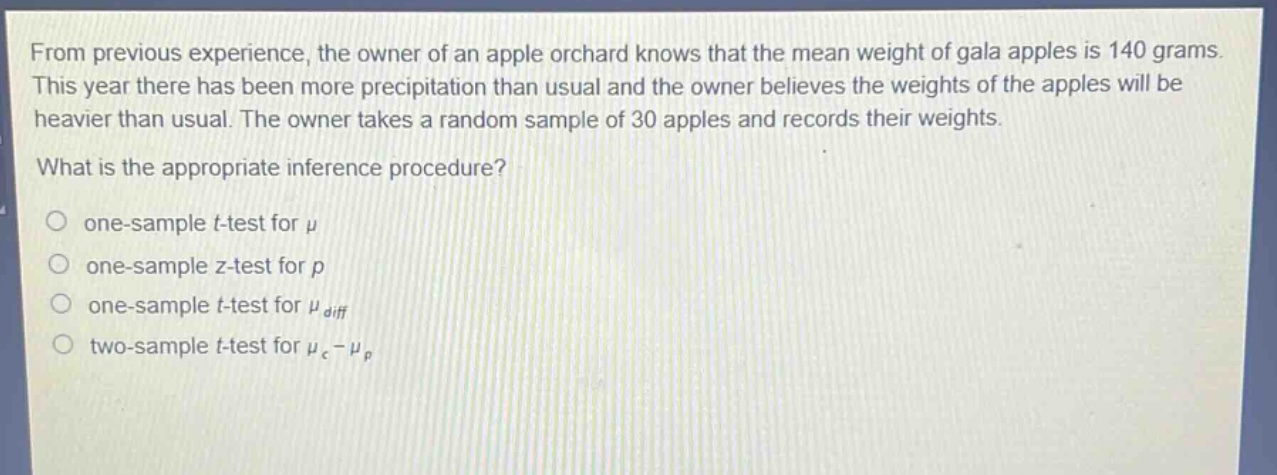
from previous experience, the owner of an apple orchard knows that the mean weight of gala apples is 140 grams. this year there has been more precipitation than usual and the owner believes the weights of the apples will be heavier than usual. the owner takes a random sample of 30 apples and records their weights. what is the appropriate inference procedure? one - sample t - test for $mu$ one - sample z - test for $p$ one - sample t - test for $mu_{diff}$ two - sample t - test for $mu_{c}-mu_{p}$
Answer
Brief Explanations:
We are dealing with a single - sample situation where we want to test a claim about the population mean weight of apples. The population standard deviation is unknown, and we have a sample size of 30. A one - sample t - test for the population mean $\mu$ is appropriate in such cases. A one - sample z - test for $p$ is for proportions, not means. A one - sample t - test for $\mu_{diff}$ is for paired data differences. A two - sample t - test for $\mu_{c}-\mu_{p}$ is for comparing two independent population means.
Answer:
one - sample t - test for $\mu$