the probability for event a is 0.3, the probability for event b is 0.5, and the probability of events a and…
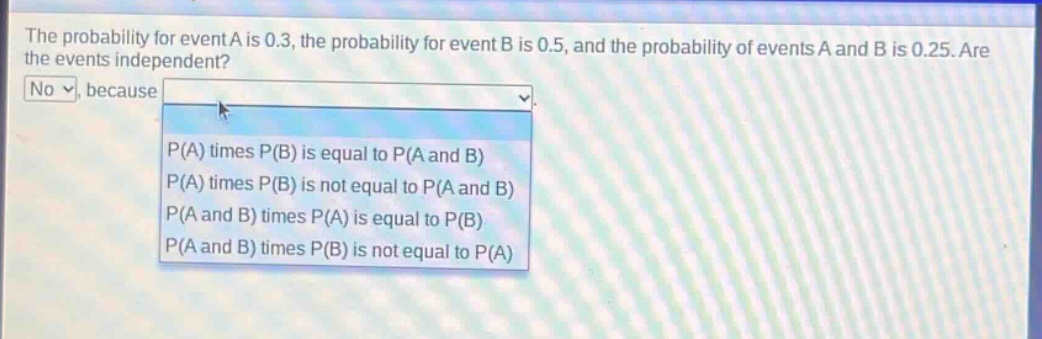
the probability for event a is 0.3, the probability for event b is 0.5, and the probability of events a and b is 0.25. are the events independent? no, because p(a) times p(b) is equal to p(a and b) p(a) times p(b) is not equal to p(a and b) p(a and b) times p(a) is equal to p(b) p(a and b) times p(b) is not equal to p(a)
Answer
Explanation:
Step1: Recall independence formula
For two - independent events (A) and (B), (P(A\cap B)=P(A)\times P(B)).
Step2: Calculate (P(A)\times P(B))
Given (P(A) = 0.3) and (P(B)=0.5), then (P(A)\times P(B)=0.3\times0.5 = 0.15).
Step3: Compare with (P(A\cap B))
Given (P(A\cap B)=0.25), and (0.15\neq0.25), so (P(A)\times P(B)\neq P(A\cap B)).
Answer:
P(A) times P(B) is not equal to P(A and B)