the probability that a random variable is greater than or equal to z standard deviations from the mean in a…
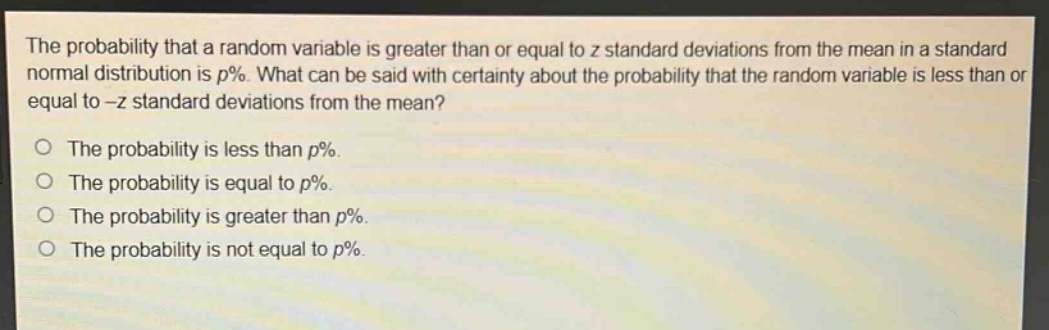
the probability that a random variable is greater than or equal to z standard deviations from the mean in a standard normal distribution is p%. what can be said with certainty about the probability that the random variable is less than or equal to -z standard deviations from the mean?\no the probability is less than p%.\no the probability is equal to p%.\no the probability is greater than p%.\no the probability is not equal to p%.
Answer
Answer:
The probability is equal to $p%$.
Explanation:
Step1: Recall property of normal distribution
The standard - normal distribution is symmetric about the mean ($\mu = 0$).
Step2: Analyze the two regions
The region of values greater than or equal to $z$ standard - deviations from the mean ($x\geq\mu + z\sigma$) and the region of values less than or equal to $-z$ standard - deviations from the mean ($x\leq\mu - z\sigma$) are symmetric about the mean. Since the standard normal distribution is symmetric about $x = 0$ (where $\mu = 0$ and $\sigma = 1$), the probability that a random variable is greater than or equal to $z$ standard deviations from the mean is the same as the probability that the random variable is less than or equal to $-z$ standard deviations from the mean.