the proportion of twins born in a town is $p = 0.12$. suppose we randomly select 100 women from this town…
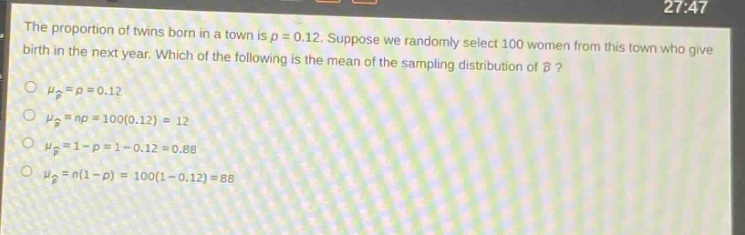
the proportion of twins born in a town is $p = 0.12$. suppose we randomly select 100 women from this town who give birth in the next year. which of the following is the mean of the sampling distribution of $hat{p}$?\n$mu_{hat{p}}=p = 0.12$\n$mu_{hat{p}}=np = 100(0.12)=12$\n$mu_{hat{p}}=1 - p=1 - 0.12 = 0.88$\n$mu_{hat{p}}=n(1 - p)=100(1 - 0.12)=88$
Answer
Answer:
A. $\mu_{\hat{p}} = p=0.12$
Explanation:
Step1: Recall sampling - distribution property
The mean of the sampling distribution of the sample - proportion $\hat{p}$ is equal to the population proportion $p$. That is, $\mu_{\hat{p}}=p$.
Step2: Identify given values
We are given that $p = 0.12$.
Step3: Determine the mean
Since $\mu_{\hat{p}}=p$, the mean of the sampling distribution of $\hat{p}$ is $0.12$.