puzzle five answer the following questions below. to break the code of puzzle five you will need to figure…
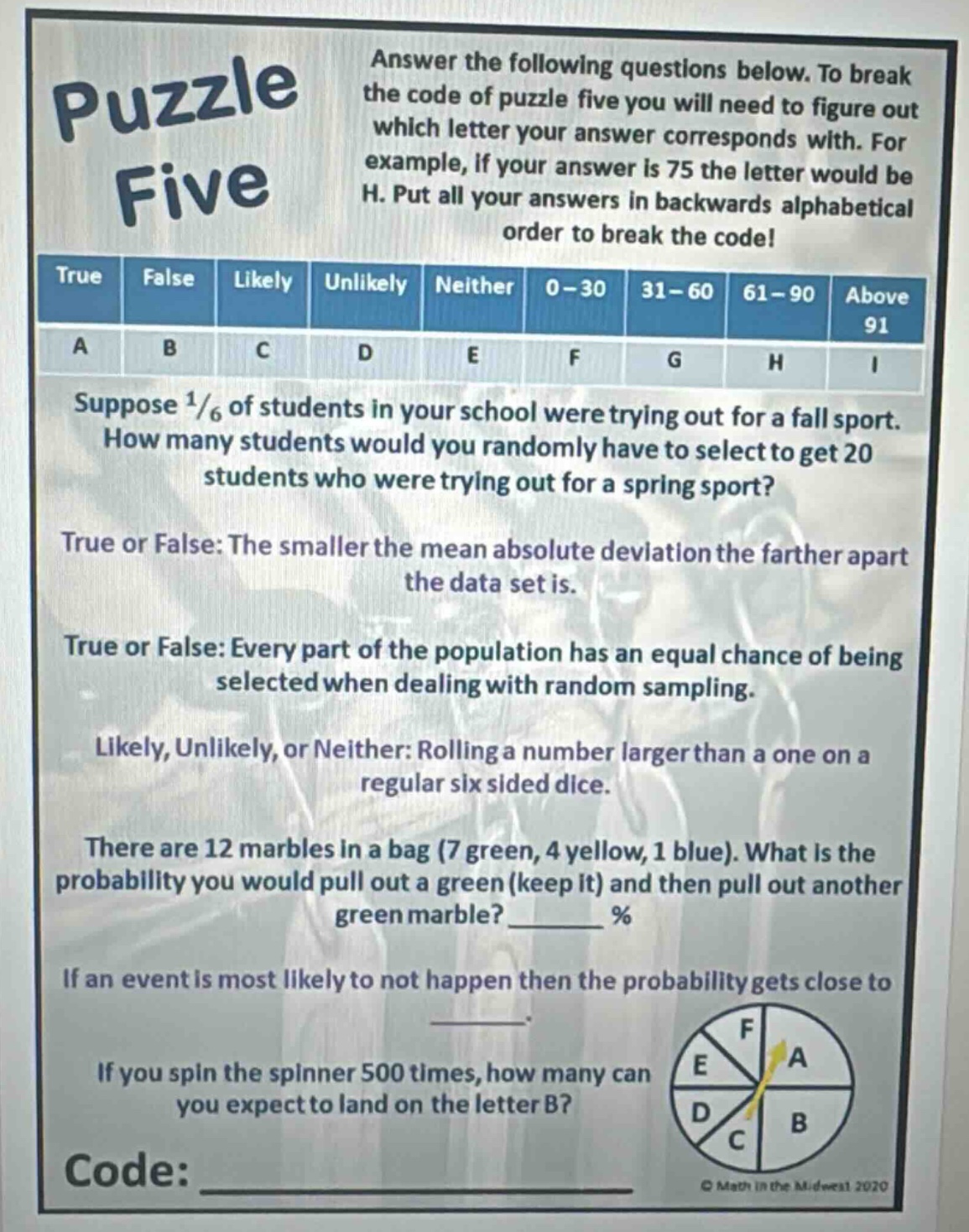
puzzle five answer the following questions below. to break the code of puzzle five you will need to figure out which letter your answer corresponds with. for example, if your answer is 75 the letter would be h. put all your answers in backwards alphabetical order to break the code! true false likely unlikely neither 0 - 30 31 - 60 61 - 90 above 91 a b c d e f g h i suppose 1/6 of students in your school were trying out for a fall sport. how many students would you randomly have to select to get 20 students who were trying out for a spring sport? true or false: the smaller the mean absolute deviation the farther apart the data set is. true or false: every part of the population has an equal chance of being selected when dealing with random sampling. likely, unlikely, or neither: rolling a number larger than a one on a regular six sided dice. there are 12 marbles in a bag (7 green, 4 yellow, 1 blue). what is the probability you would pull out a green (keep it) and then pull out another green marble? ______ % if an event is most likely to not happen then the probability gets close to ______. if you spin the spinner 500 times, how many can you expect to land on the letter b? code: ______
Answer
Explanation:
Step1: Solve the first - problem
We are given that $\frac{1}{6}$ of students are trying out for a fall sport, but we want students trying out for a spring sport. There is not enough information to solve this as no relation between fall - sport and spring - sport students is given. Let's assume it's a misprint and we want 20 students trying out for a fall sport. If $\frac{1}{6}$ of the total students are trying out for a fall sport, and we want 20 students trying out for a fall sport. Let the total number of students we need to select be $x$. Then $\frac{1}{6}x = 20$, so $x=120$. But since we can't solve it as given, we skip this for now.
Step2: Analyze the second statement
The mean absolute deviation (MAD) measures the average distance between each data value and the mean. A smaller MAD means the data points are closer to the mean, not farther apart. So the statement "The smaller the mean absolute deviation the farther apart the data set is" is False (B).
Step3: Analyze the third statement
In random sampling, every part of the population has an equal chance of being selected. So the statement "Every part of the population has an equal chance of being selected when dealing with random sampling" is True (A).
Step4: Analyze the fourth statement
On a regular six - sided die, the numbers are 1, 2, 3, 4, 5, 6. The probability of rolling a number larger than 1 is $\frac{5}{6}$, which is likely. So the answer is Likely (C).
Step5: Calculate the fifth probability
The probability of pulling out a green marble on the first draw is $\frac{7}{12}$. After keeping the first green marble, there are 6 green marbles left out of 11 marbles. The probability of pulling out a second green marble is $\frac{6}{11}$. The combined probability is $\frac{7}{12}\times\frac{6}{11}=\frac{42}{132}\approx 31.82%$. Since $31\leqslant31.82\leqslant60$, the letter is G.
Step6: Analyze the sixth statement
If an event is most likely to not happen, the probability gets close to 0. But we don't have a letter - value for 0 in the given table.
Step7: Calculate the seventh expected value
The spinner is divided into 6 equal parts. The probability of landing on B is $\frac{1}{6}$. If we spin 500 times, the expected number of times to land on B is $n = 500\times\frac{1}{6}\approx83.33$. Since $61\leqslant83.33\leqslant90$, the letter is H.
Answer:
H, G, C, A, B (in backwards alphabetical order)