q6. 8pts in a random sample of 15 dental assistants, the mean of annual earnings was $37,721 and the…
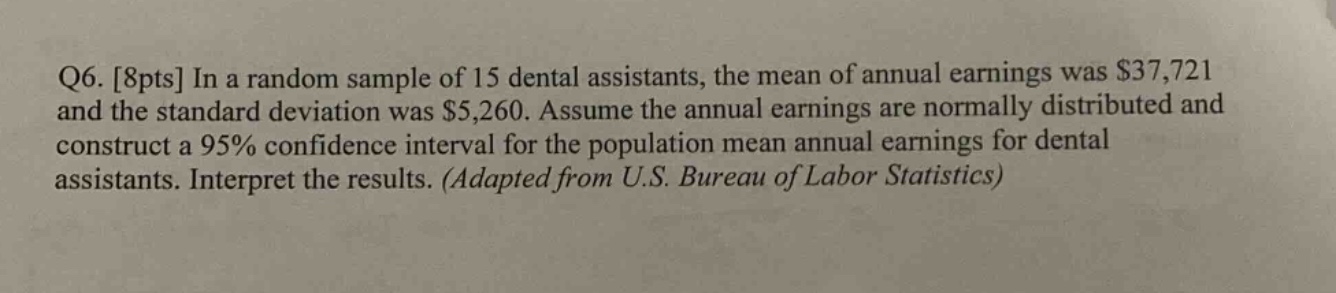
q6. 8pts in a random sample of 15 dental assistants, the mean of annual earnings was $37,721 and the standard deviation was $5,260. assume the annual earnings are normally distributed and construct a 95% confidence interval for the population mean annual earnings for dental assistants. interpret the results. (adapted from u.s. bureau of labor statistics)
Answer
Explanation:
Step1: Identify the formula
For a small - sample ($n<30$) with unknown population standard deviation and normal distribution, the confidence interval formula for the population mean is $\bar{x}\pm t_{\alpha/2}\frac{s}{\sqrt{n}}$, where $\bar{x}$ is the sample mean, $t_{\alpha/2}$ is the critical value, $s$ is the sample standard deviation, and $n$ is the sample size.
Step2: Determine the values of $n$, $\bar{x}$, and $s$
We have $n = 15$, $\bar{x}=37221$, and $s = 5260$.
Step3: Find the degrees of freedom and $t_{\alpha/2}$
The degrees of freedom $df=n - 1=15 - 1 = 14$. For a 95% confidence interval, $\alpha=1 - 0.95=0.05$, and $\alpha/2=0.025$. Looking up in the $t$-distribution table, $t_{0.025,14}=2.145$.
Step4: Calculate the margin of error $E$
$E=t_{\alpha/2}\frac{s}{\sqrt{n}}=2.145\times\frac{5260}{\sqrt{15}}\approx2.145\times\frac{5260}{3.873}\approx2.145\times1358.12\approx2913.17$.
Step5: Calculate the confidence interval
The lower limit is $\bar{x}-E=37221 - 2913.17=34307.83$. The upper limit is $\bar{x}+E=37221+2913.17 = 40134.17$.
Answer:
The 95% confidence interval for the population mean annual earnings for dental assistants is ($34307.83, $40134.17). This means that we are 95% confident that the true population mean of the annual earnings of dental assistants lies within this interval.